
As solar energy adoption continues to grow worldwide, different installation methods are being explored to maximize efficiency and space utilization. Among them, the wall mounted solar panel has gained increasing attention as an alternative to traditional roof-mounted systems. While roof installations remain the most common choice due to their direct exposure to sunlight, wall-mounted systems offer unique advantages in certain environments. However, efficiency depends on multiple factors such as angle, location, shading, and system design. Understanding the differences between these two installation methods helps users make more informed decisions for residential, commercial, or industrial solar projects.
How Wall Mounted Solar Panels Work
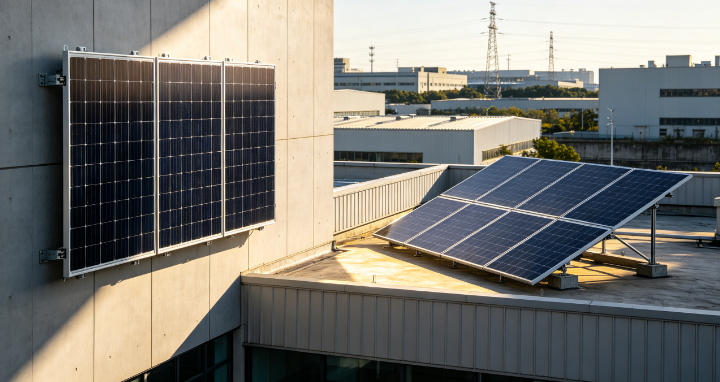
A wall mounted solar panel functions similarly to traditional solar installations but is positioned vertically or at a fixed wall angle:
- Vertical installation structure
Panels are mounted directly onto building facades or exterior walls. This allows buildings with limited roof space to still generate solar energy effectively. - Angle-dependent sunlight absorption
Since walls are typically vertical, the angle of sunlight exposure changes throughout the day, affecting energy production compared to roof systems that are usually tilted toward optimal sun direction. - Flexible installation options
Wall-mounted systems can be installed on residential buildings, commercial structures, or even sound barriers and outdoor infrastructure, depending on space availability.
Efficiency Comparison Between Wall and Roof Installations
When comparing energy efficiency, roof-mounted systems generally have a performance advantage, but wall-mounted systems still offer value in specific scenarios:
- Sunlight exposure differences
Roof installations are typically angled to capture maximum direct sunlight throughout the day, resulting in higher overall energy output. Wall-mounted systems receive more variable sunlight depending on orientation. - Seasonal performance variation
In winter, when the sun is lower in the sky, vertical wall-mounted panels may perform relatively better compared to roof panels. In summer, roof systems usually outperform due to optimal sun angles. - Shading impact considerations
Walls in urban environments may experience shading from nearby buildings, trees, or structures, which can reduce efficiency more significantly than elevated roof installations.
Advantages of Wall Mounted Solar Panels
Despite lower average efficiency in some cases, wall mounted solar panel systems offer several practical benefits:
- Space-saving solution for limited rooftops
Buildings with small or obstructed roofs can still generate renewable energy by utilizing vertical wall surfaces effectively. - Improved aesthetic integration
Modern architectural designs often incorporate solar panels into building facades, blending energy generation with visual design. - Reduced dust accumulation
Vertical panels tend to accumulate less dust, dirt, and debris compared to horizontal roof installations, potentially reducing maintenance frequency. - Safer maintenance access
Wall-mounted systems are often easier to inspect and clean without requiring rooftop access, improving long-term maintenance safety.
Advantages of Roof-Mounted Solar Systems
Roof installations remain the most widely used solar solution due to their higher efficiency and stable exposure:
- Optimal sunlight capture angle
Roof systems can be tilted to match geographic latitude, maximizing solar irradiation throughout the year. - Higher energy output consistency
With fewer shading issues and better sun exposure, roof-mounted systems typically deliver more stable electricity generation. - Better scalability for large systems
Large commercial and industrial rooftops provide ample space for installing multiple panels, supporting high-capacity energy needs.
However, in some cases, a combination of both wall and roof installations can be used to maximize total energy production.
Key Factors That Influence Efficiency
Whether choosing wall or roof installation, several important factors determine overall performance:
- Orientation and geographic location
South-facing installations (in the Northern Hemisphere) generally achieve higher efficiency. East and west-facing walls may produce lower but more balanced output throughout the day. - Tilt angle and mounting design
Adjustable mounting systems can significantly improve the performance of a wall mounted solar panel by optimizing sun exposure. - Environmental conditions
Temperature, shading, and local weather patterns all affect energy generation efficiency regardless of installation type. - System quality and component selection
High-quality solar modules, inverters, and installation hardware contribute to better long-term performance and energy conversion rates.
Conclusion
A wall mounted solar panel offers a flexible and space-efficient solution for generating solar energy, especially in buildings where roof space is limited or unsuitable. However, in terms of pure energy efficiency, roof-mounted systems generally perform better due to optimal sunlight exposure and consistent positioning. That said, wall-mounted systems can still be highly effective depending on location, orientation, and design strategy. In many modern solar projects, combining both installation types can maximize energy output while improving architectural integration. Ultimately, the best choice depends on site conditions, energy goals, and system design flexibility.
0