
Maintaining stable and reliable performance is essential for data centers, enterprise systems, and telecom infrastructures. As network speeds continue to increase, troubleshooting and diagnostics become more complex and time-sensitive. The MPO loopback has become an important testing tool designed to help engineers quickly verify signal integrity and identify potential issues in optical links. Creating a closed signal path within a single MPO interface, it enables efficient testing of transmission and reception channels without requiring full network deployment, making it a valuable solution for fast fault detection and system validation.
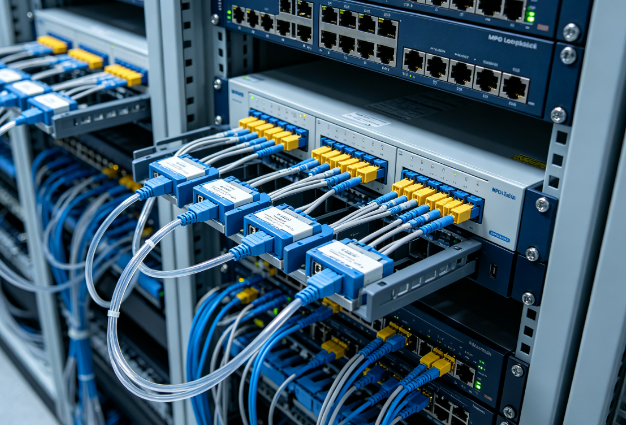
How MPO Loopback Works in Fiber Testing
The MPO loopback functions by looping the transmitted optical signal back into the receiving channel within the same connector, allowing testers to evaluate network performance.
- Signal loopback mechanism
The device physically connects the transmit (Tx) and receive (Rx) fibers inside an MPO connector, enabling signals to return to the source for analysis. This helps verify whether the optical transceiver and cabling path are functioning correctly. - Support for multi-fiber channels
Since MPO connectors support multiple fibers (such as 8, 12, or 24), loopback modules can test several channels simultaneously, significantly improving efficiency compared to single-fiber testing methods. - Real-time transmission validation
The loopback setup allows engineers to monitor signal quality, detect attenuation, and confirm whether data transmission meets expected performance standards.
Key Role in Network Fault Identification
One of the most important advantages of the MPO loopback is its ability to quickly locate and isolate network faults.
- Segment-level fault detection
By inserting a loopback module at different points in the network, technicians can determine whether issues originate from the transceiver, cable, or switch port. - Rapid isolation of faulty components
If a signal fails during loopback testing, it immediately indicates a problem in that specific link, reducing the time needed for manual inspection. - Improved troubleshooting efficiency
Instead of testing each fiber individually, engineers can evaluate multiple channels at once, significantly reducing diagnostic time in large-scale data center environments.
Applications in Data Centers and High-Density Networks
The MPO loopback is widely used in environments where high-speed and high-density connectivity requires fast and reliable testing methods.
- Data center commissioning and deployment
During installation, loopback modules are used to verify that newly deployed fiber links and switches are functioning correctly before full system activation. - Network maintenance and upgrades
When upgrading from 40G to 100G or higher-speed systems, loopback testing ensures compatibility and performance stability across new configurations. - Pre-deployment quality assurance
Manufacturers and engineers use MPO loopback devices to test optical modules and cabling assemblies before shipment or installation, ensuring compliance with performance standards.
Advantages in Efficiency and Operational Cost
Using an MPO loopback not only improves fault detection but also reduces operational complexity and cost.
- Reduced downtime during troubleshooting
Faster fault identification means network systems can be restored more quickly, minimizing service interruptions in critical applications. - Lower labor and testing costs
Since multiple fibers can be tested simultaneously, fewer manual testing steps are required, reducing technician workload and operational expenses. - Simplified testing equipment requirements
MPO loopback modules eliminate the need for complex external testing setups, making them a cost-effective solution for routine maintenance and diagnostics.
Limitations and Proper Usage Considerations
Although the MPO loopback is highly effective, it must be used correctly to ensure accurate results.
- Not a full network simulation tool
Loopback testing only verifies signal transmission within a closed path and does not replicate real-world traffic conditions or full network behavior. - Connector compatibility requirements
Different MPO polarity types and fiber counts must match the testing equipment to avoid inaccurate readings or connection issues. - Proper handling and cleaning are needed
Dust or contamination on connectors can affect test accuracy, so proper cleaning procedures are essential before use.
Conclusion
In conclusion, the MPO loopback is a highly efficient tool for identifying network faults in modern fiber optic systems. By enabling quick signal verification, multi-channel testing, and rapid fault isolation, it significantly improves troubleshooting efficiency in high-density environments such as data centers and enterprise networks. While it does not replace full network performance testing, it serves as an essential diagnostic solution that reduces downtime, lowers maintenance costs, and enhances overall network reliability. As fiber optic systems continue to evolve, MPO loopback technology will remain a critical component in ensuring stable and high-performance connectivity.
0