
Outdoor displays are often subject to several difficulties that do not arise indoors. High intensity of sunlight, temperature fluctuations, and extended periods of work affect screen readability and the operation of the device. In order to create industrial meters, parking terminals, monitoring devices, and portable instruments, it is necessary to use a display that will be clearly visible while consuming minimal power.
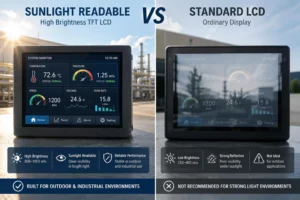
Traditional LCDs typically use LED backlighting to increase brightness. However, in bright sunlight, the intensification of the backlight does not solve the problem of visibility. Moreover, it consumes more power and reduces the battery life of portable devices.
Reflective LCD Screens utilize the light reflected from the environment and are used for creating the image. They do not depend on backlighting to the same degree as conventional LCDs and can be easily used outdoors in case of high sunlight readability and low power consumption.
How Do Reflective LCD Screens Help in Readability of the Image Under Sunlight?
Reflection of Ambient Light for Better Sunlight Readability
The main difficulty for outdoor displays is ensuring the clarity of images under bright sunlight. Traditional transmissive LCDs depend on backlight brightness, but outdoor illumination levels can greatly exceed indoor ones.
For instance:
- Illumination level in an office is about 300- 500 lux.
- Indoor office lighting is usually around 300–500 lux.
- Outdoor cloudy conditions can reach several thousand lux.
- Direct sunlight may exceed 50,000 lux.
In such conditions, an increase in backlighting might result in an increase in power consumption but would not completely solve the problem of reflections.
Reflective LCDs use ambient light as their primary source of light. These displays have a layer that reflects external light into the eyes of viewers. The advantage of this type of screen is that it provides good contrast even in outdoor conditions.
This feature is especially valuable for equipment that requires users to quickly check information in open environments, including:
- Outdoor measurement devices;
- Smart parking machines;
- Industrial monitoring terminals;
- Transportation control systems.
Reducing Glare and Improving Viewing Experience
Outdoor users often view screens from different angles and under changing light conditions. Excessive glare can make numbers, symbols, or interface information difficult to read.
A well-designed reflective display can improve viewing performance through optimized optical structures, including suitable polarizers and surface treatments. These improvements help maintain clearer information display without requiring extremely high brightness levels.
For industrial applications, better readability means operators can check equipment status faster and reduce errors caused by unclear screen information.
Why Are Reflective LCD Screens Suitable for Low-Power Devices?
Lower Energy Consumption During Long-Term Operation
Power efficiency is a key consideration for many outdoor and remote devices. Equipment installed in locations that are difficult to access cannot always rely on frequent battery replacement or maintenance.
Traditional LCD modules require continuous backlight operation, which can become a major part of the display system’s power consumption. Reflective LCD Screens reduce dependence on backlighting, helping manufacturers design products with lower overall energy usage.
Common low-power applications include:
- Remote monitoring devices;
- Smart meters;
- Portable testing equipment;
- Electronic shelf labels.
If the product is battery-operated, then any reduction in display power would contribute to extending the working period of the device and make it more convenient for users.
Longer Battery Life for Portable Devices
Battery-operated devices should strike a balance between display effectiveness and battery life. A bright display might be beneficial, but at the same time, it requires more power.
A reflective LCD Display would help to benefit from daylight when using a device in daytime. This would help to save power and work longer.
For field technicians, doctors, and outdoor workers, longer battery life equals more efficiency in their work.
Where Are Reflective LCD Screens Commonly Used?
Industrial Equipment and Outdoor Monitoring Systems
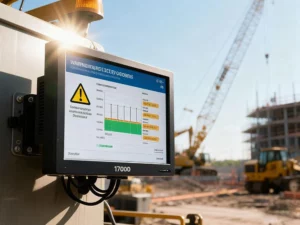
Many industrial devices are installed in areas where direct sunlight and temperature changes are unavoidable. Examples include outdoor control panels, energy monitoring systems, and measurement instruments.
These products usually require:
- Continuous operation;
- Stable display performance;
- Low maintenance requirements.
Reflective LCDs are most suitable in such cases, as they provide constant visibility without requiring high-energy backlighting.
The reason is that a technician observing any machine out in the open would be able to observe the temperature, pressure, and operations without covering the screen and constantly changing its angle of observation.
Battery Operated Mobile Units
Battery-operated equipment would require efficient power management. A display that consumes excessive energy can significantly reduce the product’s working time.
Applications include:
- Handheld inspection tools;
- Medical monitoring devices;
- Logistics terminals;
- Portable measurement instruments.
Such displays may have to work in displaying data all day long. A low-power-consumption display system enables manufacturers to enhance product usability without changing the battery size.
Smart Transportation and Public Information Displays
Equipment used in transportation has to operate in tough outdoor environments. The parking meter, the ticketing machine, and the traffic monitoring system should display clear data under all weather and lighting conditions.
The Reflective LCD Screen is the preferred type of display system because:
These devices often need to display information throughout the day
- Good sunlight readability;
- Reduced energy consumption;
- Stable long-term operation.
This makes them suitable for public equipment that needs to operate continuously with limited maintenance.
How Do Reflective LCD Screens Compare With Traditional LCD Displays?
Different kinds of LCD technology are applicable under different circumstances. The choice of the screen to use should be based on its environment.
| Feature | Reflective LCD Screens | Traditional LCD |
| Outdoor readability | Excellent | Limited under strong sunlight |
| Power consumption | Low | Higher due to backlight |
| Backlight dependence | Reduced | Required |
| Battery-powered applications | More suitable | Less efficient |
| Indoor performance | Depends on lighting | Generally strong |
The use of reflective technology makes sense for outdoor devices where low power consumption and visibility in sunlight are important.
Nevertheless, traditional LCDs can still be used indoors in places with a controlled light environment when power consumption does not matter.
What Factors Should You Take into Account When Selecting Reflective LCD Screens?
Take into Account the Display Size and Resolution
The appropriate size of the display depends on the device design and requirements of users.
The manufacturer needs to take into account:
- Available installation space;
- Amount of information displayed;
- Required image and text clarity.
For example, a simple industrial meter may only need a small display for numerical data, while an interactive terminal may require a larger screen with higher resolution.
Evaluate the Working Environment
The operating environment directly affects display selection.
Before choosing a display, consider:
- Outdoor or indoor installation;
- Temperature conditions;
- Exposure to dust or moisture;
- Power supply limitations.
For outdoor industrial products, displays often need a wide operating temperature range, such as approximately -20°C to 70°C, to ensure stable performance in different climates.
Select the Right LCD Structure
Not every application requires the same display type.
| Display Type | Main Feature | Suitable Application |
| Reflective LCD | Lowest power consumption and strong outdoor visibility | Bright outdoor environments |
| Transflective LCD | Combines reflective mode and backlight | Indoor and outdoor switching |
| Transmissive LCD | Relies mainly on backlight | Indoor applications |
Understanding the application environment helps manufacturers avoid unnecessary costs and select a more suitable display solution.
Conclusion
Outdoor equipment is in need of screens that are visible when exposed to sunlight yet regulate energy usage. Reflective LCD Screens become a good choice for industrial equipment, smart terminals, and portable devices that require good performance outdoors.
When choosing an appropriate screen for your equipment, one needs to take into consideration application conditions, size of the screen, power consumption, and operating temperature range. Correct selection of the LCD technology would help make your product more reliable and user-friendly.
0