
Considering the rising pace of global urbanization and rapid development of smart cities, LED traffic signal lights have emerged as the backbone of traffic management infrastructure. Whether it is a busy intersection in a city or a junction on a high-speed highway, LED signal lights ensure the safe journey of millions of commuters every day. However, for municipal engineering procurement officers, facility maintenance teams, and quality assessment experts, focusing solely on surface brightness is no longer enough. Gaining a deep understanding of the internal precision structure of LED traffic signal lights is not only the key to ensuring the long-term stable operation of traffic systems, but also a core prerequisite for evaluating product quality and optimizing lifecycle maintenance costs. This article provides a comprehensive analysis of the internal architecture and key technical modules of LED traffic signal systems to empower professional decision-making in project procurement and technical evaluation.
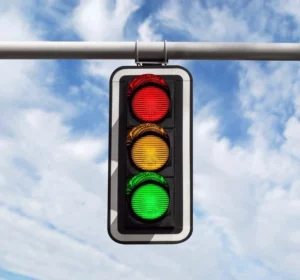
1. Core Lighting Module: The Heart of LED Traffic Signal Lights
As the visual and operational powerhouse of the entire assembly, the illuminating module directly dictates the luminous efficiency, color purity, and operational lifespan of led traffic signal lights. This module typically integrates a high-efficiency semiconductor light-emitting diode array coupled with advanced thermal engineering.
In advanced traffic light design such as that used by Sinowatcher, the key light source components are based on technical specifications that include:
- Light Efficacy and Power Consumption: The luminous efficacy of a single chip is often above 130 lm/W, and the power consumption of the module remains between 10 W and 15 W, providing an 80% savings in energy as compared to conventional incandescent lamps.
- Wavelength Control: Red light wavelengths remain within the range of 620nm to 625nm, whereas those of green light stay within the range of 505nm to 508nm, thus allowing for good visibility in strong sunlight.
- Heat Dissipation: Heat dissipation technology using MCPCB ensures that the junction temperature (Tj) does not exceed 65°C; therefore, a failure-free lifespan of over 100,000 hours is guaranteed.
2. Optical System: How Lenses Shape LED Traffic Signal Lights
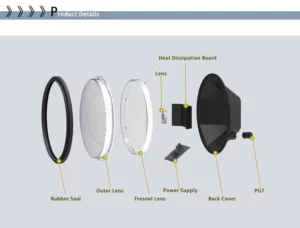
The optical system is responsible for scientifically reshaping and precisely distributing the light beams generated by the illuminating module, ensuring that drivers and pedestrians can clearly perceive directional signals from designated angles while preventing stray light from causing visual interference.
To ensure that LED traffic signal lights comply with international road traffic standards (such as EN 12368 or ITE specifications), the optical design typically incorporates the following crucial components:
| Optical Component Name | Material and Craftsmanship | Core Function and Technical Specifications |
| Primary Lens | High-transmittance optical-grade PMMA or PC | Closely fits the LED chip to initially converge divergent light, achieving a light transmittance rate exceeding 92%. |
| Fresnel Lens Array | Polycarbonate with UV-resistant coating | Achieves uniform beam distribution, confining the viewing angle precisely within a horizontal 30° and vertical 5° visual window. |
| Visor and Anti-Ghost Shield | Engineering flame-retardant ABS or polycarbonate | Effectively prevents the “ghost effect” caused by oblique sunlight reflections. |
3. Housing and Enclosure: Protecting LED Traffic Signal Lights Outdoors
The harsh conditions of the outdoors present a serious challenge to the robustness of traffic signal lights. With rain, frost, heat, or sandstorms, the housing body should offer an impregnable physical shield to the sensitive electronic components contained within.
The specifications that high-end LED traffic signal light housings generally utilize include the following in structure and material engineering:
- Ingress Protection: The sealing requirement is required to be at least IP65 or even higher, up to IP67. This makes the housing dust-tight and able to withstand powerful sprays of water coming from any direction.
- Material Choice: Housing bodies normally make use of die-cast aluminum alloy materials or UV-stabilized engineering plastics that ensure both lightweight and excellent impact resistance (IK08).
- Structure Sealing: Silicone sealing rings with resistance to high temperatures and aging are combined with stainless steel bolts and screws to prevent any chance of moisture infiltration and corrosion risk.
4. Power Supply and Driver Board: Powering LED Traffic Signal Lights
The power source and driver circuit board act as the brain and arterial blood supply to the whole unit. The power source is able to convert alternating current (such as AC 85V-265V) or low-voltage direct current (such as DC 12V/24V) into steady current to drive LEDs.
In assessing the reliability of industrial LED traffic signal lights, it’s necessary to take into account the following technical characteristics of the power module:
- Compatibility with Grid Supply: The product is equipped with a wide input voltage to cope well with the frequent voltage fluctuations in urban electricity supply systems.
- Protection against Surge: Equipped with a high-class lightning protection circuit design, capable of bearing an immediate voltage of 4kV to 6kV to avoid damage to the equipment caused by storms.
- Power Factor: Premium driver power sources have a power factor greater than 0.90, minimizing grid harmonic contamination and reducing energy loss.
Famous brands such as Sinowatcher incorporate intelligent current control and correction techniques in their multi-channel intelligent signal light control systems. As each LED chip ages due to natural causes, the driver board will automatically make tiny changes in the output current to ensure that the luminous flux is still within the regulatory standards for an extended period of time and minimize the patrol and maintenance intervals required by municipal authorities.
Conclusion
To sum up, contemporary LED traffic signal lights are far from being mere physical assemblies of LEDs and external housings; instead, they are technologically advanced systems that involve semiconductor materials technology, optical engineering, heat management, and intelligent power driving technology. From the high luminous efficacy and precise wavelength control of the core lighting module to the scientific beam shaping and anti-glare processing of the optical system; from the rigorous outdoor protection reaching IP65/IP67 standards to the high-standard surge protection and intelligent current compensation embedded in the driver board—every single technical detail directly determines road traffic safety coefficients and equipment operational lifespans.
0