
In modern manufacturing, industries are increasingly demanding higher precision, faster production cycles, and the ability to handle complex product designs. Traditional machinery and manual operations often struggle with tasks that require multi-angle processing and high consistency. This is where the 5 axis robot arm becomes highly valuable. With its advanced motion capabilities and intelligent control systems, it is widely used in both assembly and machining environments. However, many manufacturers still ask whether it is truly capable of handling complex industrial tasks effectively.
Multi-Axis Motion Enables Complex Task Execution
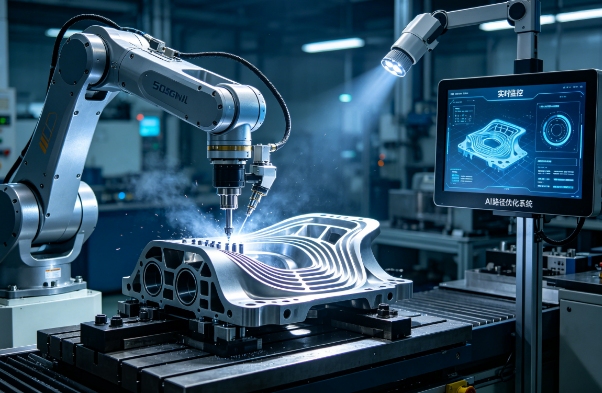
One of the core strengths of a 5 axis robot arm is its ability to move across multiple directions simultaneously, making it suitable for complex assembly and machining operations.
- It can rotate and position tools from multiple angles, allowing access to hard-to-reach areas of a workpiece.
- Compared with traditional 3-axis systems, it eliminates many repositioning steps, improving machining continuity.
- In precision cutting or drilling, it maintains optimal tool orientation throughout the entire process.
- Complex curved or irregular surfaces can be processed more efficiently due to their flexible movement range.
This advanced mobility significantly expands the range of tasks it can handle in industrial environments.
High-Precision Control for Machining Accuracy
Complex machining tasks require extremely stable accuracy, and the 5 axis robot arm is designed to meet these requirements through advanced control systems.
- It maintains consistent movement precision across long production cycles, reducing dimensional errors.
- Fine motion control enables micrometer-level adjustments during machining operations.
- Integrated sensors help monitor tool position and correct deviations in real time.
- Stable force control ensures smooth cutting, grinding, or polishing without damaging materials.
These capabilities make it highly suitable for industries such as aerospace, automotive, and precision engineering.
Efficient Handling of Complex Assembly Tasks
Assembly processes often involve multiple components, precise alignment, and repetitive positioning, all of which can be efficiently managed by a 5 axis robot arm.
- It ensures accurate placement of components even in tight or multi-layered assemblies.
- Multi-angle movement allows it to reach internal or hidden assembly positions easily.
- Automated force control helps prevent over-tightening or damage during assembly operations.
- Consistent repetition improves product uniformity across large production batches.
This makes it particularly effective for the assembly of electronic products, automotive components, and medical devices.
Intelligent Integration for Adaptive Manufacturing
Modern manufacturing requires adaptability, and the 5 axis robot arm integrates well with intelligent systems to handle complex and changing tasks.
- It can be connected to vision systems for real-time object recognition and alignment.
- AI-based path optimization improves efficiency during multi-step machining processes.
- Sensor feedback allows the system to adjust operations dynamically based on real-world conditions.
- Automated programming makes it easier to switch between different assembly or machining tasks.
This level of intelligence enhances its ability to manage complex industrial workflows efficiently.
Stability and Efficiency in High-Volume Production
Handling complex tasks is not only about capability but also about maintaining stability in mass production environments. The 5 axis robot arm delivers both.
- It reduces production errors caused by manual operation inconsistencies.
- Continuous operation capability ensures stable output during long production runs.
- The optimized motion path reduces unnecessary movements and improves cycle efficiency..
- A lower defect rate helps reduce material waste and rework costs.
These advantages make it highly reliable for industries requiring both complexity and scale.
Conclusion
The 5 axis robot arm is fully capable of handling complex assembly and machining tasks due to its multi-axis flexibility, high-precision control, intelligent integration, and stable performance in high-volume production. Its ability to manage intricate movements and maintain consistent accuracy makes it an essential technology in modern manufacturing. With the continued growth of industrial demand, this advanced robotic solution will play an increasingly important role in enhancing efficiency, precision, and automation capabilities across various industries.
0