
A glasses free 3d display has become one of the most discussed innovations in modern visualization technology, promising immersive 3D experiences without the need for headsets or special eyewear. Unlike traditional stereoscopic systems, it relies on optical layers, multi-view rendering, and sometimes eye-tracking to simulate natural depth perception. The key question is whether a glasses free 3d display can truly achieve accurate depth perception in real time, especially under dynamic viewing conditions such as head movement, multi-user environments, and fast-changing content. While the technology has advanced significantly, real-time depth accuracy still depends on multiple technical constraints, including rendering speed, viewing angles, and optical precision.
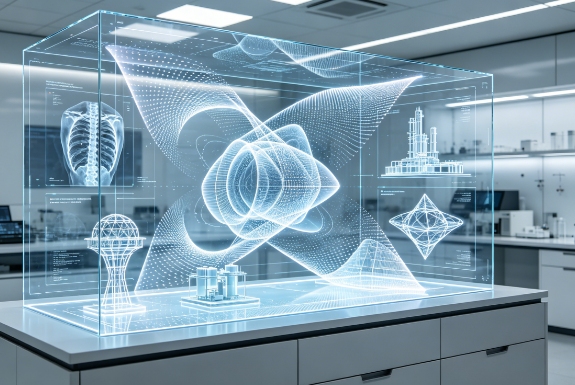
Core Mechanism Behind Real-Time Depth Perception
To understand how a glasses free 3d display works, it is essential to break down its depth-generation mechanism, which mimics how human eyes perceive spatial differences.
- Multi-view image generation:
The system renders several slightly different perspectives of the same scene, allowing each eye to receive a unique image. This creates binocular disparity, the foundation of depth perception. - Directional light control:
Optical layers such as lenticular lenses or parallax barriers guide specific pixels toward each eye, ensuring correct image separation without glasses. - Real-time rendering synchronization:
High-performance GPUs continuously update multiple viewpoints, ensuring that movement or scene changes are reflected instantly without visible delay. - Dynamic viewpoint adaptation:
Advanced versions integrate eye-tracking to adjust image alignment based on user position, improving the stability of perceived depth.
Together, these mechanisms allow the display to simulate three-dimensional space, making real-time depth perception possible, though still dependent on system precision.
Key Technical Factors Affecting Depth Accuracy
The accuracy of depth perception in a glasses free 3d display is influenced by several interdependent technical elements that determine visual consistency and realism.
① Display resolution and pixel density
Higher pixel density allows smoother depth gradients, reducing jagged edges and improving object separation in 3D space.
② Frame rendering speed and GPU load
Real-time performance requires rendering multiple image streams simultaneously. Any lag can disrupt depth continuity and reduce immersion.
③ Viewing angle stability and sweet spot range
If the viewer moves outside the optimal zone, depth cues may distort, causing flattening or ghosting effects.
④ Optical layer precision (lens/barrier alignment)
Even minor misalignment between optical components can lead to image leakage, reducing stereoscopic clarity.
⑤ Content depth mapping quality
Poorly constructed 3D models or incorrect depth data can mislead perception, even if hardware performance is strong.
These factors collectively determine how accurately depth is perceived in real-time environments.
Performance Challenges in Real-Time Scenarios
Although a glasses free 3d display offers significant innovation, real-time depth accuracy still faces several practical limitations that affect widespread adoption.
- Multi-user depth inconsistency:
When multiple viewers are present, each at different angles, the system struggles to maintain accurate depth cues for everyone simultaneously. - Latency in fast motion scenes:
Rapid object movement or user head rotation can cause slight delays in updating viewpoints, leading to temporary depth mismatch. - Crosstalk and image overlap issues:
Light leakage between left-eye and right-eye images can produce ghosting effects, reducing the perceived sharpness of depth layers. - High computational demand:
Real-time multi-view rendering significantly increases processing requirements, limiting performance on lower-end systems. - Eye fatigue over long exposure:
Continuous depth adjustment may cause visual strain due to inconsistencies between accommodation and convergence cues.
These challenges show that while real-time depth perception is achievable, maintaining accuracy under all conditions remains complex.
Application Scenarios Demonstrating Depth Capability
Despite limitations, a glasses free 3d display is already being applied in industries where real-time spatial understanding is critical.
- Medical imaging and surgical planning
Doctors can visualize anatomical structures in 3D, improving spatial awareness during procedures. - Industrial design and prototyping
Engineers evaluate mechanical structures in real time, allowing faster iteration without physical models. - Education and scientific simulation
Students interact with complex 3D models, such as molecular structures or astronomical systems, enhancing comprehension. - Entertainment and interactive media
Gaming and digital signage benefit from more immersive environments that respond dynamically to user movement.
Each use case demonstrates that while perfect accuracy is still evolving, real-time depth perception is already practical and valuable.
Conclusion
In conclusion, a glasses free 3d display can deliver real-time depth perception, but its accuracy depends on a combination of hardware precision, rendering performance, optical design, and content quality. The technology successfully replicates many aspects of human binocular vision, yet challenges such as limited viewing angles, processing demands, and image crosstalk still affect consistency. However, ongoing advancements in eye-tracking, light field rendering, and GPU optimization continue to improve performance. As these technologies mature, real-time depth perception will become increasingly accurate, positioning this display innovation as a strong candidate for next-generation immersive visual systems.
0