
The transflective LCD is a hybrid display technology that balances ambient light and built-in backlighting to maintain clear visibility in different environments. Unlike traditional LCDs that rely mainly on backlights, it uses reflected sunlight in bright conditions and activates backlighting in darker settings. This adaptive lighting design improves readability, reduces power consumption, and makes the display ideal for outdoor equipment, portable devices, and industrial systems.
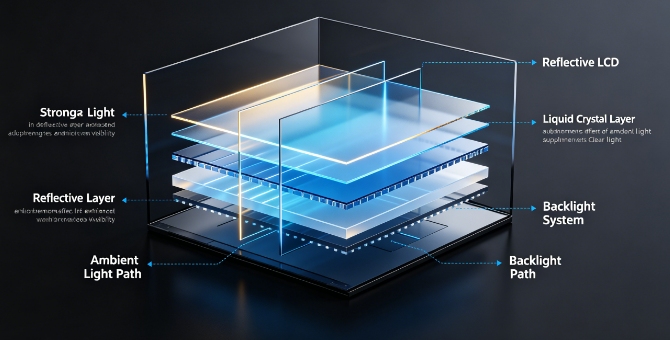
Dual Optical Structure for Light Control
The core reason a transflective LCD can balance different light sources is its specially designed dual-layer optical structure.
- Reflective layer function: A semi-reflective layer is placed within the display to bounce ambient light back toward the viewer, improving visibility in bright environments.
- Transmissive Layer Function: When ambient light is insufficient, this structure allows backlight illumination to pass through.
- Liquid crystal modulation system: Liquid crystals control how much light is transmitted or blocked at each pixel, forming the displayed image.
- Integrated optical harmony: Both reflective and transmissive functions work together without requiring separate display modes.
This layered structure is the foundation that enables the transflective LCD to adapt smoothly between different lighting conditions.
How Ambient Light Is Utilized Effectively
Ambient light plays a major role in reducing power consumption and improving outdoor readability.
Key ways ambient light is used:
- Sunlight reflection enhancement
In bright environments, incident light is reflected by the display screen’s internal layers, effectively illuminating the screen without the need for extensive use of backlighting. - Contrast improvement in daylight
Strong external light increases perceived brightness and makes text and images easier to read. - Reduced reliance on internal lighting systems
When ambient light is sufficient, the display automatically reduces its backlight brightness. - Stable visibility under natural conditions
Outdoor users benefit from consistent readability even when viewing angles or lighting direction change.
This efficient use of ambient light allows the transflective LCD to perform well in sunlight-heavy environments.
Role of Backlight in Low-Light Environments
While ambient light is useful outdoors, backlighting becomes essential when external lighting is insufficient.
- Automatic backlight activation: The system detects low light conditions and activates the backlight for visibility.
- Brightness adjustment control: Backlight intensity is dynamically adjusted based on ambient light levels.
- Energy-efficient operation mode: Instead of running at full brightness continuously, the system optimizes light output.
- Consistent image clarity: Even in complete darkness, the display maintains clear readability through controlled illumination.
This ensures that the transflective LCD remains functional and readable in both indoor and nighttime environments.
Adaptive Balance Mechanism Between Two Light Sources
The most important feature of this display technology is its ability to continuously balance ambient light and backlight in real time.
- Real-time light sensing: Built-in sensors detect environmental brightness levels and adjust display output accordingly.
- Adaptive light balancing: The display combines reflected ambient light with transmitted backlight to preserve clear contrast levels.
- Energy optimization logic: When ambient light increases, backlight usage decreases automatically.
- Smooth transition behavior: The display avoids abrupt changes, ensuring a stable viewing experience during lighting shifts.
It is precisely this adaptive mechanism that enables transflective LCDs to simultaneously maintain both high efficiency and readability across a wide range of conditions.
Practical Performance in Real-World Applications
The ability to balance light sources makes this technology extremely valuable across many industries.
- Outdoor industrial equipment: Machines operating in construction or agriculture benefit from clear visibility under sunlight and reduced energy consumption.
- Transportation systems: Vehicle dashboards and navigation devices must remain readable in both day and night conditions.
- Portable field devices: GPS units and handheld scanners rely on adaptive brightness for long battery life and outdoor usability.
- Marine and aviation systems: These environments require stable visibility under constantly changing lighting conditions.
In all these applications, the transflective LCD ensures reliable performance regardless of environmental lighting.
Conclusion
The transflective LCD achieves its performance advantage by intelligently balancing ambient light and backlight through a dual-layer optical structure and adaptive brightness control system. By using reflected sunlight in bright conditions and switching to controlled backlighting in darker environments, it maintains clear visibility while optimizing energy consumption. This balance makes it particularly effective for outdoor, industrial, transportation, and portable applications where lighting conditions are unpredictable. Ultimately, its ability to seamlessly integrate two light sources is what sets it apart from traditional display technologies and makes it a reliable solution for modern real-world usage.
0