
Coating thickness should also be considered when discussing the ability of galvanized anchor rods to resist corrosion because the galvanized coating may either be too thick or too thin.
If the coating is too thick, then the rod may end up being corroded, but if the coating is too thin, then the rod may not screw in due to insufficient coating.
1. What Coating Thickness Is Required for Galvanized Anchor Rods?
No global minimum thickness for zinc coating of anchor rods exists. Hot-dip galvanizing results in a different coating than that obtained through electrogalvanizing.
1.1 What Is the Typical Zinc Coating Thickness for Anchor Rods?
Hot-Dip Galvanizing
In hot-dip galvanization, prepared steel is dipped into molten zinc and creates zinc-iron alloy layers underneath a layer of zinc metal. Typically, this process yields fairly thick coatings ideal for many outdoor uses.
As per ISO 1461, products made of steel and having a thickness of more than 6 mm will have a local coating thickness of at least 70 μm and an average coating thickness of at least 85 μm. It is important to note that the above figures may not apply in all cases of threaded anchor rods.
A typical application is ONTONBOLT’s HDG Coating Self-drilling Anchor Rods. These hot-dip galvanized rods are used in slope stabilization, retaining wall support, and related ground reinforcement projects. Their coating requirements must be considered alongside thread geometry, coupler compatibility, and underground corrosion conditions.
Electro-Galvanizing
Electro-galvanizing makes use of electrochemistry to create a zinc layer on steel. The zinc layer that is electro-galvanized is normally thinner and more uniform.
The thickness of the zinc layer that can be electroplated is generally between 5 and 25 microns. They are usually selected for non-corrosive environments.
| Process | Illustrative Thickness | Main Characteristic |
| Hot-dip galvanizing | 70–85 μm minimum values for certain ISO 1461 products | Generally thicker coating |
| Electro-galvanizing | 5–25 μm in some applications | Generally thinner, uniform finish |
These values illustrate typical differences rather than universal acceptance limits.
1.2 How Does Coating Thickness Affect Corrosion Protection?
With equal exposure conditions, an increase in the thickness and integrity of the zinc coating means an increase in the amount of reserve material.
Two examples with coating thicknesses of 50 μm and 85 μm. Zinc loses about 2 μm per year:
50 μm: 50 ÷ 2 = 25 years
85 μm: 85 ÷ 2 = 42.5 years
However, the calculations do not represent the actual life expectancy since they are just for reference purposes, and the rate of corrosion depends on factors such as moisture, chlorides, air pollutants, soils, etc. There are also restrictions on the zinc coating thickness. Excess zinc coating may make fitting nuts to threads difficult.
1.3 Which Standards Specify Zinc Coating Thickness?
There are several standards available for zinc coating thicknesses, but each standard has a different scope.
ASTM F2329/F2329M – Standard specifications for hot-dip galvanized coating for certain threaded steel fasteners.
ASTM A153 /A153M -Standard Specification for Zinc Coatings on Selected Iron and Steel Hardware.
ISO 1461 – Hot-dip galvanized coatings on certain fabricated steel products.
ISO 10684 – Hot-dip galvanized coating for certain threaded fasteners, including thread compatibility.
It is crucial to select standards according to the design and classification of the anchor rod. The point to remember here is that an 85 µm thickness may not be relevant in all cases of galvanized anchor rods.
2. How Is Coating Thickness Measured on Galvanized Anchor Rods?
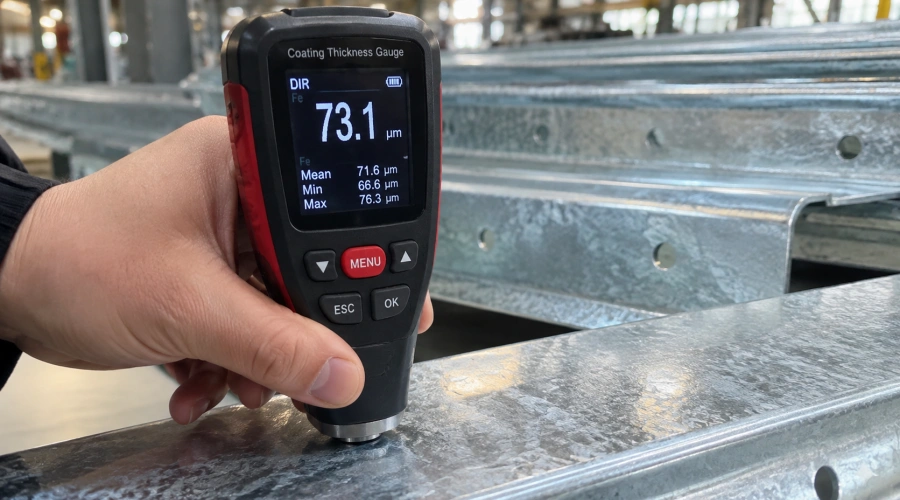
Thickness measurement is critical for coating inspection. The measurement technique chosen should be appropriate for the product configuration and the standard that applies.
2.1 Which Methods Are Used to Measure Zinc Coating Thickness?
Magnetic Thickness Measurement
Gauges that make use of magnetic principles for film measurement are used to measure non-magnetic zinc films coated onto steel components. They are not destructive in nature but certain aspects may affect results from their use. The measurement of threaded surfaces must be done carefully.
Microscopic Cross-Section Measurement
The section can then be analyzed using a microscope for measurement of thickness and structure. This technique offers a lot of information, although it is normally destructive.
Gravimetric Measurement
The gravimetric analysis process determines the weight of the coating material on the metal substrate per square meter following standard test protocols. It is useful to note that the specific gravity of pure zinc is approximately 7.14 grams per cubic centimeter.
An equivalent coating thickness of 85 microns, therefore, should ideally weigh around 607 grams per square meter of substrate.
2.2 What Should Be Checked During Coating Thickness Inspection?
Local and Mean Thickness
Some of the specifications include both local and average thickness specifications. A single satisfactory reading does not guarantee that the whole component complies with the specifications.
Threads and Connections
Inspect threaded areas for excessive zinc buildup and assembly problems. Self-drilling anchor systems also require compatible couplers.
Surface Condition
Check for uncoated areas, excessive deposits, and defects affecting installation. A shiny appearance alone does not establish coating quality.
Inspection Records
Reports should identify the applicable standard, measurement method, results, and production batch. This allows test data to be traced to delivered products.
2.3 What Common Coating Thickness Inspection Mistakes Should Be Avoided?
However, some mistakes can be made, causing an erroneous conclusion regarding inspection:
• Use of one measurement: Coating thickness may vary from one point on the element to another.
• Choosing the wrong parameters: Different standards are applied to the structural steel and screws.
• Forgetting about the fitting of the thread: Even though the coating passes all thickness tests, it still may affect assembly.
• A problem with mixing coating thickness and service life: Humidity and water underneath can influence the coating’s ability to prevent rusting.
Inspection of coating for an anchor used underground needs to be considered as a whole during general durability analysis.
Conclusion
The coating thicknesses for galvanized anchor rods depend on how the products have been galvanized and what products are being galvanized. Also, galvanized rods through the hot-dip process have a thicker coating than those galvanized through electro-galvanizing.
Testing should be done using proper techniques to check for the coating thickness and thread fit. Environmental exposure of these products should also not be forgotten.
0