
Fiber optic cables are frequently employed outdoors, in industrial settings, and even underground. However, regular cables might become vulnerable to being crushed, rodents, and extreme weather conditions. An Armoured Fibre Optic Cable provides extra protection. The cable design, materials, and mechanical characteristics determine where it can be installed and how it will operate.
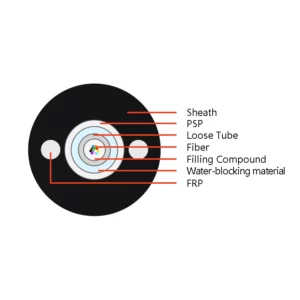
1. What Is an Armoured Fibre Optic Cable?
An Armoured Fibre Optic Cable is a communication cable with an extra protective layer that is placed on the fiber structure. It differs from conventional cables with its reinforcement, which allows it to become more resistant to mechanical loads.
The most typical design consists of:
- Optical Fibers: Used for transmission of data via light waves. The most popular types of optical fibers are single-mode G.652D and multimode OM2, OM3, and OM4.
- Loose Tube: Usually manufactured from PBT, the loose tube protects and houses the optical fibers.
- Water Blocking Material: Special filling substances, yarn, and tapes are used to prevent the penetration of moisture inside the cable.
- Armor Layer: Consists of steel tape, steel wire, or non-metallic materials for protection from mechanical impact.
- Outer Jacket: PE and PVC are used most often. PE is commonly used outdoors due to its water- and weather-resistant properties.
Every layer has a different purpose. Fibers transmit the signals, and the armor protects them from any damage. However, armor does not necessarily ensure the waterproof properties of the cable.
2. Benefits of an Armoured Fibre Optic Cable
The extra reinforcement makes armored cables appropriate in environments where standard cable protection might not be enough.
2.1 Better Mechanical Protection
Steel armor ensures more even distribution of pressure and minimizes possible damage done by heavy machinery, construction equipment, or accidental impact. Steel tape protects the cable against radial crush only, whereas steel wire provides greater tensile strength.
2.2 Increased Resistance to Rodents
Rodents may chew off the outer jacket of the cable and cause damage to inner fibers. The metal armor serves as an extra layer preventing rodents from reaching internal parts of the cable. It is especially effective in underground ducts, building cavities, and outdoor installations.
2.3 Increased Moisture Protection
Cables used outdoors are exposed to rain, moist soil, and water. Water-blocking compound and yarns protect the cable against moisture penetration inside. Together with the PE outer jacket, these materials ensure extra protection against environmental factors.
2.4 More Flexible Installation Options
Depending on its design and test ratings, an armored cable can be installed in underground ducts, industrial environments, and outdoor communication lines. Moreover, there are some designs suitable for direct burial.
3. Types of Armoured Fibre Optic Cable
Various armor materials provide various protective properties. There are three most popular designs worth your consideration.
3.1 Steel Tape Armoured Fibre Optic Cable
This kind employs a steel tape armor with a corrugated shape over the inside structure of the fiber optic cable. The corrugation enables effective distribution of the external pressure while still providing some flexibility of the cable.
Main characteristics are:
- Excellent resistance to radial crush.
- Extra protection against rodent damage.
- Ability to be used outdoors and underground.
Steel tape armor is popular when there is considerable concern about external pressure and mechanical damage.
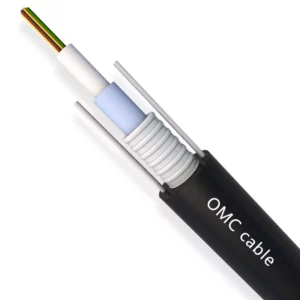
For high-capacity outdoor networks, OMC offers the 144F Stranded Loose Tube Double Sheath Armored Cable. With a 144-fiber configuration, stranded loose tube construction, and double-sheath design, it is intended for communication projects that require higher fiber capacity and additional cable protection. Its construction makes it a suitable option for outdoor network infrastructure where reliable long-term performance is important.
3.2 Steel Wire Armored Fiber Optic Cable
A steel wire gives additional protection from mechanical damage and gives the cable good tensile properties.
It is handy in situations where considerable pulling forces are involved, as it can be used outdoors.
Important specifications to know are:
- Tensile load – maximum pulling force the cable can withstand during specific tests.
- Resistance to crush – ability of the cable to resist external pressure applied perpendicularly to the cable axis.
- Both short- and long-term ratings need to be considered to prevent excessive mechanical stress during the installation process.
3.3 Non-Metallic Armored Fiber Optic Cable
In non-metallic armors, glass yarn or aramid yarn is used. They differ from the metallic armors by the absence of the conducting metallic layer.
Glass yarn can provide tensile reinforcement and increased rodent resistance (it depends on the density and construction). Glass-armored cables are suitable for those cases where electrical isolation, reduced weight, or low metal content is required.
But their mechanical properties are different from those of steel-reinforced cables.
4. Armoured Fibre Optic Cable vs. Non-Armoured Fiber Optic Cable
Both cable types transmit optical signals, but their physical protection and installation requirements differ.
| Comparison | Armored Cable | Non-Armored Cable |
| Mechanical protection | ★★★★★ | ★★☆☆☆ |
| Crush resistance | ★★★★☆ | ★★☆☆☆ |
| Rodent resistance | ★★★★☆ | ★★☆☆☆ |
| Flexibility | ★★★☆☆ | ★★★★★ |
| Weight | ★★★☆☆ | ★★★★★ |
| Installation convenience | ★★★☆☆ | ★★★★★ |
| Initial cost | ★★★☆☆ | ★★★★★ |
Note: These ratings are illustrative comparisons, not standardized test grades. Actual performance depends on cable construction.
4.1 Mechanical Protection
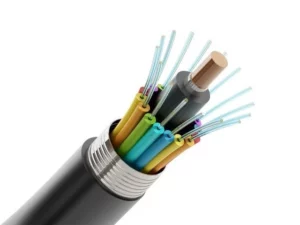
An Armoured Fibre Optic Cable gives enhanced resistance to exterior pressure and any form of physical damage. The Non-Armoured Cables depend solely on jackets and internal strength members. As such, they are best suited for safe indoor installations in enclosed conduits.
4.2 Weight and Installation
Armor leads to heavier cables. It may also lead to an increase in the size of the cables.
Non-Armored Cables are relatively lighter and easier to work with. However, they all require proper bending radius and installation tension to avoid damaging the fibers.
4.3 Cost and Application
Armored cables are relatively expensive to make. But they reduce the risk of damage, especially in harsh environments.
Non-Armored Cables are normally cheaper to install because of the existing protective measures.
5. Conclusion
The selection of an Armoured Fibre Optic Cable should be based on the installation environment and mechanical properties of a particular cable. The Steel Tape provides adequate crush resistance while the Steel Wires offer enhanced tensile strength.
Non-Metallic reinforcements provide an alternative when less metallic content is desired.
By understanding the number of fibers, the type of armor, the tensile loads, crush resistance, bending radii, and temperature ranges, installers will be able to choose a durable and appropriate cable.
0