
While optimizing the traffic flow in your facility, upgrading the warehouse loading dock, or remaking your city’s intersection, you will face one of the key technical decisions – whether to implement the plug-and-play or traditional hardwired LED traffic signal. Project managers and engineers tend to argue about this question before making their procurement orders since the complexity of installation, maintenance, and cost of running these two systems vary greatly. Here is the technical review of both solutions that may help you choose the most effective configuration of hardware for your needs.

1. What is a plug-and-play LED traffic signal?
A plug-and-play LED traffic signal is a modern warning and signaling device engineered specifically for rapid deployment. This configuration removes the heavy reliance on complex trenching and permanent conduit wiring that traditionally plagues traffic installation projects. To fully understand the technical composition and operational logic of this system, we can break it down into three distinct aspects:
Core Technical Architecture and Power Supply
From a structural standpoint, plug-and-play systems utilize an integrated design. Their standard operating voltage typically ranges from 110V to 220V AC, while mobile or compact warning variants often operate on safe 12V or 24V DC power inputs. The underlying logic relies on pre-assembling the signal controller, wireless radio frequency modules (such as remote clickers supporting transmission ranges between 250 and 700 feet), and the optical housing into a unified unit prior to shipment.
Typical Product Examples and Deployment
In modern industrial and commercial settings, these units are deployed widely. For instance, when managing fast-paced mid-sized distribution hubs that require rapid setup and flexible workspace reallocation, operational teams frequently implement reliable hardware solutions such as the Sinowatcher LED Traffic Signal in its plug-and-play configuration. Featuring robust impact-resistant housings and high IP ratings, it allows workers to mount the unit quickly to a wall and power it up immediately via a modular wireless control box.
Primary Advantages and Ideal Use Cases
The ultimate benefit of this setup is instantaneous operational readiness. Technicians simply secure the fixture to a pole or bracket, plug it into a standard power source, and pair the wireless key fob or 3-position switch box. This approach suits facilities lacking resident electricians, tight project timelines, or environments where layout configurations change frequently.
2. What is a hardwired LED traffic signal?
In contrast to mobile or modular setups, a traditional hardwired LED traffic signal serves as the structural bedrock for permanent transportation networks and heavy-duty industrial infrastructure. This method mandates that installation crews physically run cables through protective conduits to connect the signal head directly to a central control room, a Programmable Logic Controller (PLC), or a dedicated master traffic controller.
2.1 Technical Specifications and Circuitry Standards
Technically speaking, a hardwired LED traffic signal connects directly to standard utility grids, accepting wide voltage inputs from 85V to 265V AC. The internal circuitry incorporates precision constant-current driver boards, integrated surge protection devices, and phase-control modules compliant with strict roadway guidelines. Because it eliminates wireless relay stages, the physical hardwire connection provides zero-latency signal transmission.
2.2 Typical Product Examples and Deployment
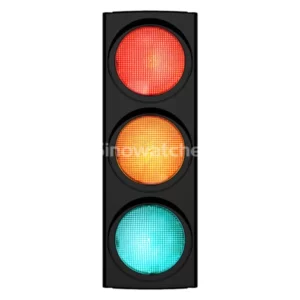
Market options engineered for permanent mounting typically feature heavy-duty die-cast aluminum or UV-stabilized polycarbonate shells rated at IP65 or higher. For instance, when engineering a long-term urban intersection or a high-capacity manufacturing assembly line requiring decades of continuous operation, contractors often specify the hardwired version of the Sinowatcher 300mm Aluminum LED Traffic Signal. By tying multiple optical heads directly into subterranean wiring and central automation networks, facilities achieve uninterrupted performance under heavy daily cycles.
2.3 Primary Advantages and Ideal Use Cases
The main benefit of having a hardwired system is that it has better tolerance to electromagnetic interference and weather damage. It ensures a stable and strong signal output during many transitions per day. The hardwired system is a must-have in terms of municipal roads and industrial automation areas.
3. A Comprehensive Comparison: Which LED Traffic Signal Solution Is Right for You?
Now that we have looked into the mechanics and examples of equipment for each LED traffic light, it is critical to determine how each LED traffic light fits in line with your budget requirements and return on investment.
Below is a comparison chart showing important operating parameters:
| Comparison Dimension | Plug-and-Play Type | Hardwired Type |
| Installation Time & Labor Cost | Very low (can typically be completed independently within a few minutes to hours) | Higher (requires professional electricians for wiring, conduit routing, and system commissioning) |
| System Stability & Anti-Interference | Relies on wireless RF, with a very low probability of signal delay or interference | Physical direct wired connection, featuring extremely high anti-interference and real-time performance |
| Device Relocation Flexibility | Very high (easy to disassemble, suitable for temporary construction sites or frequently adjusted production lines) | Very low (once fixed and wired, relocation costs are high) |
| Initial Cost and Total Cost of Ownership | Higher initial cost but greatly reduces labor costs for wiring | Moderate initial cost but total installation and maintenance costs are relatively high |
A plug-and-play configuration is ideal where there are only temporary yard locations or indoor warehouse configurations that change regularly, or where existing conduit does not exist. On the other hand, when one considers projects over a period of ten years or more, like main streets in a city, weigh stations, or standard industrial floors, then a hardwired solution is the way to go.
4. Conclusion
In conclusion, it is necessary to understand that the decision on plug-and-play or hard-wired LED traffic signals must be made by taking into consideration all the specifics of the project, the situation at the site, and the limitations regarding the budget.
By weighing these factors against your timeline and long-term infrastructure goals, you can select the solution that delivers optimal safety and cost-efficiency.
0