
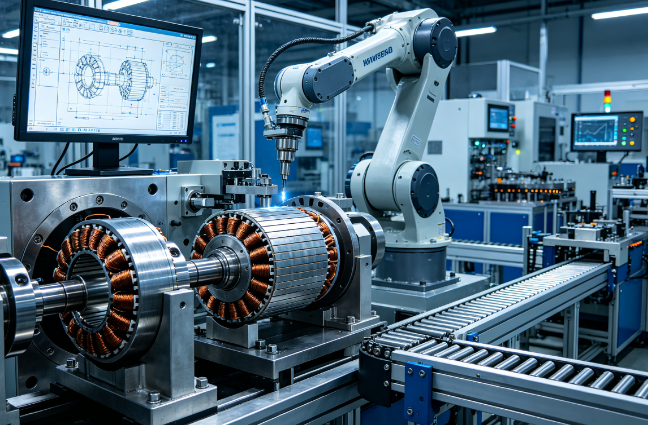
Motor manufacturing is a highly precise and systematic industrial process used to produce electric motors that power a wide range of equipment, from household appliances to industrial automation systems. The process involves multiple stages, including engineering design, material preparation, component production, assembly, and performance testing. Each stage plays a crucial role in ensuring the final product delivers stable performance, energy efficiency, and long service life. As global demand for automation continues to grow, modern motor manufacturing has become increasingly dependent on advanced machinery, digital simulation, and strict quality control to meet high industrial standards.
Engineering Design and Technical Planning
The first stage in motor production focuses on detailed engineering design and planning, which determines overall performance and efficiency:
- Performance parameter definition
Engineers set key specifications such as voltage, torque, rotational speed, and power output. These parameters guide the entire production process and ensure the motor matches its intended application.
- Electromagnetic and mechanical design optimization
Computer-aided design tools are used to optimize magnetic field distribution, reduce energy loss, and improve mechanical balance, ensuring higher efficiency and stability.
- Material selection strategy
In motor manufacturing, selecting the right materials is essential. High-grade silicon steel, copper wire, and heat-resistant insulation materials are chosen to improve conductivity and durability.
- Prototype simulation and validation
Before mass production, virtual simulations and sample prototypes are tested to detect potential performance issues and refine the design.
Component Fabrication and Material Processing
Once the design is finalized, individual components are manufactured with high precision:
- Stator and rotor core processing
Steel laminations are stamped, stacked, and treated to form the stator and rotor cores, reducing eddy current loss and improving magnetic efficiency.
- Copper winding production
Automated winding machines wrap copper wires around stator slots with consistent tension and spacing to ensure stable electrical performance.
- Shaft machining and structural parts creation
The motor shaft, housing, and end covers are machined with tight tolerances to guarantee mechanical alignment and smooth rotation.
- Insulation treatment application
Protective insulation layers are applied to prevent electrical leakage, short circuits, and thermal damage during long-term operation.
Assembly and System Integration
After individual components are ready, they are assembled into a complete motor system:
- Rotor and stator integration
The rotor is carefully placed inside the stator with precise alignment to minimize friction and maximize efficiency.
- Electrical wiring and connection setup
Internal wiring systems are installed to connect coils, sensors, and external power interfaces, enabling controlled operation.
- Bearing installation and lubrication
High-quality bearings are added to support rotation, while lubrication systems reduce wear and extend operational lifespan.
- Protective housing assembly
The outer casing is sealed to protect internal components from dust, moisture, and mechanical impact.
Testing and Quality Control Process
Quality assurance is a critical stage in ensuring reliability and safety:
- Electrical performance testing
Motors are tested for voltage stability, current efficiency, and load capacity under different operating conditions.
- Mechanical endurance evaluation
Long-duration testing simulates real-world usage to assess durability, vibration resistance, and structural integrity.
- Thermal performance monitoring
Temperature sensors evaluate heat distribution to ensure the motor operates safely without overheating.
- Noise and vibration analysis
Engineers measure operational sound levels and vibration intensity to ensure smooth and quiet performance.
Automation and Production Efficiency Enhancement
Modern motor manufacturing relies heavily on automation to improve consistency and output:
- Robotic assembly systems
Automated machines handle component assembly with high precision, reducing human error and increasing production speed.
- Real-time quality monitoring
Sensors and digital systems continuously monitor each production stage to detect defects early and maintain quality standards.
- Large-scale batch production control
Manufacturing lines are designed for high-volume production while maintaining uniform product quality.
- Data-driven process optimization
Production data is analyzed to improve efficiency, reduce waste, and enhance long-term manufacturing performance.
Conclusion
In conclusion, motor manufacturing is a highly structured process that combines engineering design, precision component production, careful assembly, and strict quality testing. Each stage plays an essential role in ensuring the final motor delivers reliable performance, energy efficiency, and long service life. With the integration of automation and advanced manufacturing technologies, modern production systems are capable of achieving higher accuracy and consistency than ever before. As industrial demand continues to grow, innovation in motor manufacturing will remain a key driver of efficiency and technological progress across global industries.
0