
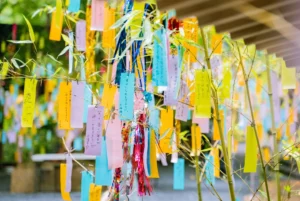
Every summer, bamboo branches wrapped with brightly colored paper pieces can be seen all around in Japan – in shopping streets, schools, public places, and even in homes. Such decorations are linked to Tanabata, the Japanese Star Festival. A traditional bamboo Tanabata decoration can consist of narrow wish papers, origami cranes, clothes, money bag-like items, fishing nets, streamers, and other paper-made items.
Such decorations are not hung randomly on the bamboo. Each shape has its own meaning, which can relate to studying, craftsmanship, health, longevity, harvest, or prosperity. The most identifiable part of the decoration is the Tanzaku, a small piece of colored paper where individuals’ wishes can be written.
1. Where Did the Japanese Tanabata Tradition Come From?
Tanabata did not originate in Japan through one particular Japanese custom but was a result of several customs existing before its emergence. One of those customs is the Chinese legend of Orihime and Hikoboshi, symbolized by the constellations Vega and Altair. According to the legend, the lovers are separated by the Milky Way, and only once a year can they meet each other.
The custom found its way into Japan many years ago and became connected with courtly culture, weaving, seasonal observation, and prayers for improving the crafts. With time, Tanabata moved from the court and turned into a festival practiced by communities, schools, families, and business districts.
Also, the date is different because the celebration of Tanabata was based on the lunar calendar initially. While some regions celebrate the holiday in mid-July, some important festivals like Sendai Tanabata happen in August.
The custom of decorating bamboo came into existence as the festival began spreading around the country. Wishes were attached to bamboo stalks along with handcrafted ornaments made of paper that hung from them.
Thus, there are three elements of the Tanabata festival decorations:
- Bamboo: the natural framework for the display.
- Paper ornaments: handmade symbols representing different wishes.
- Tanzaku: written statements of personal hopes and goals.
Tanabata therefore became more than a story about two stars. It became a seasonal occasion for people to express specific wishes for their own lives.
2. Why Is Bamboo Used for Tanabata Decorations?
Bamboo is especially useful in decorating for the festival owing to the nature of the material. Bamboo branches are slim, flexible, and easily moved in wind currents. This enables paper decorations to be visible while moving even without mechanical devices.
Use of bamboo also makes sense because of the nature of Tanabata tradition. One can simply write one’s wish on the paper and attach it to bamboo branches and transform regular bamboo into a wish display.
A typical Tanabata decoration may contain several different paper objects:
| Decoration | Japanese Name | Traditional Association |
| Wish paper | Tanzaku | Personal wishes, study, skills, career |
| Paper crane | Orizuru | Health and long life |
| Money pouch | Kinchaku | Financial prosperity |
| Fishing net | Toami | Good harvest or abundant catch |
| Paper clothing | Kamigoromo | Textile skills and improvement in craftsmanship |
| Long streamer | Fukinagashi | Weaving thread and Orihime |
| Decorative paper ball | Kusudama | Good fortune and visual decoration |
However, it does not mean that all the Tanabata festivals use the exact set of decorations. Traditions vary depending on location, so the decoration layout used in one city will not be similar to that used in another.
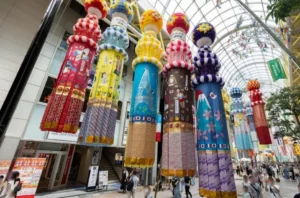
For instance, the **Sendai Tanabata Festival** is famous for its spectacular decorations. Long streamers made of paper hang in the air over the streets of shopping areas, and seven kinds of decorations play a key role in the festive atmosphere of the event.
3. What Does Tanabata Bamboo Decoration Mean?
In order to reveal the meaning of Tanabata decoration, it is necessary to analyze the meaning of each particular ornament.
Tanzaku: Wishes
Tanzaku refers to narrow strips of colored paper. Wishes or aspirations are written on them and then attached to bamboo sticks.
Traditionally, wishes were closely associated with writing skills, poetry, weaving, etc. The contemporary Tanzaku includes a much wider variety of goals – from passing the examination to success in work, health maintenance, or achieving any personal goal.
It is noteworthy that because wishes are written by participants themselves, Tanzaku makes the ornament interactive.
Orizuru: Paper Crane
The folded paper crane has a connection with long life and good health. Origami cranes are also very popular in Japan and have a symbolism that refers to longevity.
In Tanabata decoration, several cranes can be folded and hung on the bamboo along with other objects.
Kinchaku: Money Pouch
The Kinchaku is a bag for holding coins or money. It is also used for keeping small personal items. The presence of this object in the Tanabata decoration is a sign that people wish for wealth and prosperity.
This object is quite easily recognized due to its bag-like form.
Toami: Fishing Net
The Toami looks like a fishing net. The symbolism of this decoration means a good catch and abundance.
Kamigoromo: Paper Clothing
Kamigoromo is a piece of clothing made from paper. This ornament relates Tanabata to the figure of Orihime, who is associated with weaving in the original story.
The ornament may symbolize better sewing or weaving and skill improvement.
Fukinagashi: Long Streamers
Long streamers are one of the most prominent decorations used in Tanabata displays. The shape of these objects is connected to weaving thread and thus, to Orihime.
When it comes to large displays organized publicly, the streamers may be several meters long, which creates the typical vertical motion in the Tanabata festivals.
Kusudama: Decorative Paper Ball
Kusudama is a paper ball that is usually placed either on top of or around long streamers. This paper ball serves both a symbolic and decorative purpose in modern Tanabata displays.
These seven ornaments transform a bamboo branch into a cluster of wishes.
4. How Is Tanabata Bamboo Decoration Used Today?
Tanabata bamboo decoration is currently being used for various purposes other than decorating houses. There are schools that can give out bamboo decorations where people can write down their wishes. There are shopping malls and department stores that will set up decorations where visitors can attach tanzaku. Other places like railway stations, community centers, shrines, and commercial streets can set up Tanabata displays.
One very clear example of how the Tanabata decoration has evolved to become a grand display is the Sendai Tanabata festival. It has been around for more than 400 years and is known for decorating its shopping street with big paper ornaments hanging on bamboo sticks.
The modern-day Tanabata decoration is also practical in terms of designing events and interiors:
- Natural structure: Bamboo offers a light, vertical framework without having to use a complex support structure.
- Man-made involvement: People are allowed to handwrite their wishes and place them in an existing design.
- Variable decoration: The paper decorations may be altered based on the venue in terms of color, shape, size, and pattern.
- Appropriate for commercial use: Stores, cultural activities, Japanese-themed events, schools, and community festivals may use the concept without having to duplicate the entire traditional festival.
- Flexible materials: Instead of using the traditional paper, it may be substituted or complemented with recycled paper, cloth, reusable structures, or any other material.
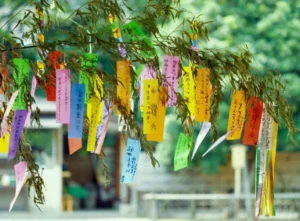
The key is that the identifiable features remain the same: bamboo, hanging paper decorations, Tanzaku, and writing of wishes.
Conclusion
The decoration of Tanabata bamboo combines the natural element of bamboo along with paper, writing, and traditions. Tanzaku allows an individual to write his or her wishes and goals, while the cranes, money bags, fishing nets, clothing made of paper, and streamers are some of the various symbols of hope.
Currently, such decorations are seen in schools, shops, public buildings, and even festivals like Tanabata in Sendai. The form might vary depending on the location, but the construction of such decorations is rather easy to identify – the paper decoration hangs from bamboo with personal wishes added to it.
For everyone interested in the culture of Japanese festivals, Tanabata bamboo decoration is a good example of how a tradition becomes a physical artifact of the myth.
0