
Every year, on October 31, there are pumpkin carvings, costumes, candies, and various decorations that can be seen anywhere – houses, stores, streets. Halloween includes wearing costumes, pumpkin carving, and trick-or-treating.
However, behind the mentioned tradition, there is a whole story that dates back a long time ago. The relation between Halloween and the Samhain festival is in its celebration at the end of the harvest time.
There are many aspects of the holiday Halloween that have a historical background, such as the invention of the Jack-o’-lantern or Trick-or-Treating.
Halloween Origins
It is known that the origins of Halloween can be traced back to the celebration of the holiday Samhain, during which Celts used to celebrate the end of the harvest and the start of the dark season. It should be noted that the period from October 31st to November 1st had great importance for the Celts.
In accordance with ancient legends, the border between the real world and the world of spirits became thin during this time. Spirits were allowed to visit the living beings on Earth creating a mysterious night.
Bonfires and peculiar outfits were typical for these days. It was not just fun, as it is today, to wear costumes. Some historical interpretations connect disguises with the belief that people could hide from or confuse supernatural beings.
As Christianity began to spread to certain areas in Europe, the pre-existing seasonal customs were linked with Christian practices. The month of November was associated with All Saints’ Day, while the night before this day was called All Hallows’ Eve, which later became “Halloween.”
This rich history is the reason why Halloween is filled with various cultural symbols. Some of the traditions date back to a very long time ago, while others have developed quite recently.
Why Are Pumpkins, Costumes, and Candy Trademarks of Halloween?
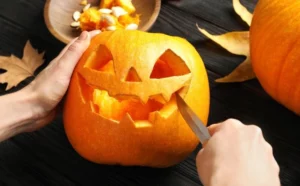
If we talk about a symbol that would be considered the most representative of Halloween, then probably it would be a jack-o’-lantern. All you need to do is go for a stroll in your neighborhood at the end of October, and you will see many jack-o’-lanterns.
However, initially, the pumpkin was not the vegetable to be carved into this lantern.
In certain regions of Ireland and Scotland, turnips, beets, and various root vegetables have been carved into lanterns. The vegetables had holes carved out and then decorated with faces, with a light source put inside. Upon the migration of Irish people to North America, pumpkins began to replace turnips as lanterns because of the availability and size of pumpkins.
The term “Jack-o’-lantern” also owes its origins to the folklore tale of Stingy Jack of Ireland. In the tale, Stingy Jack deceives the devil but in the end ends up roaming about in eternal darkness with a burning coal, the latter forming the basis of the lamp in the later tradition.
How Did Trick-or-Treat Become a Halloween Tradition?
The Halloween festivity without the practice of Trick-or-Treat would be incomplete for most children.
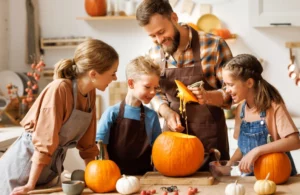
During the night of October 31st, most children dress up in costume and go knocking at doors in their neighborhood. With the ring of the bell and the words “Trick or Treat,” most children end up with some kind of gift.
Such a modern activity traces its roots in some traditions that date back to medieval times in Europe. There is a practice in which poor folks visit houses and request food in return for prayers made to the souls of their deceased loved ones. Such activities were called “souling.” Later similar traditions included children going around asking for food, money, or gifts.
Trick-or-Treat as we know it today gained popularity in the U.S. during the 20th century when candies could easily be distributed among kids.
Traditional figures such as witches, ghosts, vampires, and skeletons remain popular for this holiday; yet, people can wear absolutely any costume nowadays. From children to adults, people can put on costumes based on their favorite movies, cartoons, video games, animals, famous people, or even invent their own ones.
In other words, the holiday has become more than just scary.
How is Halloween Celebrated Worldwide?
The greatest cultural tradition of celebrating Halloween is prevalent in the United States and Canada; however, nowadays, people can encounter Halloween decorations and activities in many other countries too.
The method of celebration strongly depends on culture.
| Country or Region | Common Halloween Features |
| United States | Trick-or-Treat, costumes, candy, home decoration, parties |
| Canada | Costumes, candy, home decoration, community events |
| Ireland | Halloween traditions connected with Celtic history |
| United Kingdom | Pumpkin carving, costumes, parties, seasonal decorations |
| Mexico | Día de los Muertos, a separate tradition with its own cultural meaning |
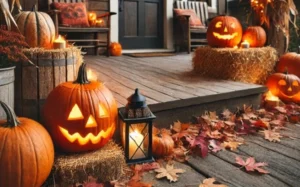
There has also been a lot of creativity in Halloween decorations. One household can place a couple of pumpkins near the entrance, whereas another can turn its whole garden into a scary atmosphere. Tombstones, skeletons, large spiders, ghosts, bats, fog machines, LED lights, projectors, and other items can be used for decorating.
The holiday decorations have become not just about celebrating but also an element of modern seasonal decor. The beautifully decorated shop or house becomes an inviting environment that prompts people to stop for a photo shoot.
Conclusion
Halloween has changed from its roots in ancient Celts in several ways, but many of its recognizable features have come about due to traditions established over many years.
Currently, features like pumpkins, candies, costumes, skeletons, witches, bats, black cats, spider webs, and lights for Halloween help to recognize this holiday. This is because these features have helped people recognize Halloween despite its youth in certain areas.
It is the blend of history and creativity that makes Halloween special. It is not just a holiday dedicated to ghosts and scary figures. It is also a cultural tradition formed by seasonal traditions, folklore, cuisine, clothing, decor, entertainment, and other aspects of celebrations within different societies.
0