
As the electric vehicle (EV) market continues to grow, charging speed has become a key factor influencing user experience. Many EV owners focus on fast charging technology when selecting public charging stations or planning long trips. Among various charging options, the CCS fast charger (Combined Charging System fast charger) has become one of the most widely used fast-charging standards due to its versatility, speed, and broad compatibility. In this article, we will explore what a CCS fast charger is and how it works.
What Is a CCS Fast Charger?
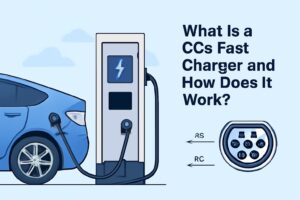
The CCS (Combined Charging System) fast charger is a direct current (DC) fast charging standard widely used in Europe, North America, and some parts of Asia. It integrates both alternating current (AC) and direct current (DC) charging interfaces into a single, unified design, allowing the same charging port to be used for different charging methods. This means that EVs can use AC charging at home and DC fast charging at public stations, offering a flexible and efficient charging solution.
How Does a CCS Fast Charger Work?
Understanding how it works can be broken down into three main mechanisms: DC fast charging, intelligent communication systems, and dynamic power regulation.
1. DC Fast Charging Delivers High Power Output
Unlike home AC chargers, a CCS fast charger uses direct current to supply power to the vehicle’s battery. The DC power bypasses the onboard AC charger and goes directly to the battery, allowing for much higher power output. Many CCS fast chargers can charge an EV from 10% to 80% in just 20-40 minutes, greatly improving charging efficiency.
2. Bi-Directional Communication Between Charger and Vehicle
During the charging process, the CCS system constantly communicates with the vehicle, monitoring factors such as battery temperature, state of charge (SoC), current, and voltage. This continuous communication allows the charger to dynamically adjust the power output. Ensuring that it operates within safe limits, which enhances charging efficiency while protecting the battery’s health and longevity.
3. Dynamic Power Regulation Ensures Battery Safety and Health
As the battery’s charge level increases, especially after it reaches around 80%, the power output is automatically reduced to enter the “topping off” phase. This approach prevents the battery from being subjected to high currents and voltages for extended periods, which could accelerate degradation. Thus, while the charging speed is fast during the early stages, it slows down to ensure that the battery is charged safely and effectively.
Advantages of a CCS Fast Charger
1. Reduces Charging Time
Compared to AC charging, which may take several hours, using a CCS fast charger can complete a major charge in just a fraction of that time—typically 20-40 minutes. This makes it ideal for daily commuting, quick top-ups, or for longer trips, where stopping for a brief charge is more convenient.
2. High Global Compatibility Across Brands
Nearly all major EV brands in Europe and North America support the CCS fast-charging standard, making it one of the most universally compatible public fast-charging interfaces. No matter where you are—whether in urban centers, suburban areas, or along highways—you can easily find CCS fast-charging stations that work with your EV.
3. The Best Charging Solution for Travel and Long-Distance Journeys
With fast charging speeds and a large number of charging stations, many highway service areas, and shopping malls. And charging network operators are now adopting CCS fast chargers as their standard charging option. This gives EV owners the confidence to plan routes more freely, reducing “range anxiety” during long trips.
Conclusion
In simple terms, a CCS fast charger is a high-power, intelligent, and highly compatible direct current fast-charging technology. It delivers energy directly to the battery, providing significantly faster charging times compared to AC chargers. At the same time, it relies on real-time communication between the charger and the vehicle to monitor factors like battery temperature, voltage. And state of charge, automatically adjusting power output to ensure the process is efficient and safe. Moreover, the standardized CCS interface ensures compatibility with a wide range of major EV brands. Making it one of the most widespread and popular fast-charging solutions worldwide.
0