
1. What is Glasses-Free 3D?
A glasses free 3d display is an advanced visual technology that allows viewers to perceive three-dimensional content without the need for any specialized eyewear. Unlike traditional 3D displays, which require polarized or active shutter glasses to separate images for each eye, glasses-free 3D displays employ optical technologies such as lenticular lenses or parallax barriers to direct different images to the viewer’s eyes simultaneously. This creates an immersive visual effect, making objects appear with depth and realism.
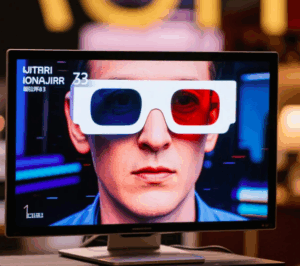
2. How Does a Glasses-Free 3D Display Work?
- Lenticular Lens Technology
The most common technology behind a glasses free 3d display is the lenticular lens system. In this approach, a series of cylindrical lenses are aligned over the display panel, each directing light from different pixels toward specific viewing angles. Each eye receives a unique image, producing the stereoscopic effect that simulates depth perception. For example, a 7.9-inch glasses-free 3D display might employ over 2 million micro-lenticular lenses to maintain a high pixel density of 330 PPI (pixels per inch), producing a sharp and realistic 3D effect without noticeable artifacts.
- Parallax Barrier Technology
Another technique uses a parallax barrier, a layer with precisely spaced slits placed in front of the display panel. This barrier directs light to each eye separately. While generally more straightforward to implement than lenticular lenses, parallax barriers typically reduce brightness and may require precise viewing distances. A high-end glasses free 3d display often combines parallax barriers with full HD or 4K panels to maintain clarity and depth perception across multiple viewing angles.
- Multi-View Rendering
Advanced glasses free 3d display systems use multi-view rendering to create multiple perspective images simultaneously. Each perspective is displayed at a slightly different angle, allowing several viewers to experience the 3D effect from different positions. For instance, a 65-inch display may render 8 to 16 views, ensuring accurate depth representation for multiple viewers without loss of visual fidelity.
3. Advantages of Glasses-Free 3D Displays
- No Glasses Required – The most obvious benefit of a glasses free 3d displayis the elimination of glasses, enhancing user comfort and engagement.
- Immersive Experience – Multi-view rendering and lenticular technology provide realistic depth perception and high-quality stereoscopic effects.
- Wide Application – Ideal for consumer electronics, interactive kiosks, industrial design, and medical imaging.
- Enhanced Collaboration – Allows multiple viewers to share a 3D experience without specialized equipment, improving communication in professional settings.
4. Emerging Developments in Glasses-Free 3D Displays
Glasses free 3d display technology is evolving rapidly, with several notable trends:
- Improved Brightness and Contrast
New panels are designed to maintain vivid colors and sharp depth effects, even in bright indoor or outdoor environments.
- More Viewing Angles
Advanced systems can now support up to 16 perspectives, ensuring multiple viewers experience the 3D effect clearly from different positions.
- Slimmer and Lighter Designs
Ultra-thin panels allow glasses free 3d display technology to be integrated into portable devices, wall-mounted systems, and space-limited environments.
- Wider Application Scenarios
The technology is increasingly used in interactive kiosks, educational platforms, medical visualization, and large-scale digital signage, expanding beyond entertainment alone.
5. Commercial Applications of Glasses-Free 3D Displays
Glasses free 3d display technology is increasingly applied in commercial signage, entertainment, and professional visualization:
- Advertising and Retail – 3D content grabs attention in shopping malls and public spaces without requiring viewers to wear glasses. Brightness and color accuracy are crucial in these applications, with typical panels reaching 450–500 cd/m².
- Industrial Design and Engineering – 3D product prototypes and CAD models can be reviewed on large-format displays without cumbersome eyewear.
6. 3D LED Displays vs. Glasses-Free 3D
Here’s your paragraph converted into a clear bullet-point format while keeping the keyword naturally integrated:
- Traditional 3D LED displays offer excellent brightness and color performance.
- Most 3D LED displays require glasses or headsets, which limits accessibility.
- In contrast, a glasses free 3d displaydelivers immersive depth perception without additional accessories.
- Modern glasses free 3d displaysolutions often combine lenticular or parallax technologies with UHD or 4K panels.
- Small devices achieve high pixel density up to 326 PPI, while large screens maintain 110–140 PPI.
- 3D LED displays ensure precise rendering of 3D content for multiple viewers simultaneously.
7. Conclusion
A glasses free 3d display combines optical engineering, multi-view rendering, and high-resolution display technology to deliver immersive 3D experiences without glasses. While cost and brightness considerations exist, the advantages in user experience, collaborative visualization, and commercial impact make glasses free 3d display technology a rapidly growing choice for professional, consumer, and industrial applications.
0