
In early childhood education, flash cards have long been used as a simple and effective learning tool for teaching vocabulary, numbers, and basic concepts. However, with the development of educational technology, talking flash cards educational toys have emerged as a modern alternative that significantly enhances the learning experience. While traditional flash cards rely solely on visual recognition and repetition, talking versions integrate audio, interaction, and multisensory engagement. This fundamental difference has changed the way children learn and interact with educational content. Understanding how these two tools differ can help parents and educators choose the most effective learning method for different developmental stages.
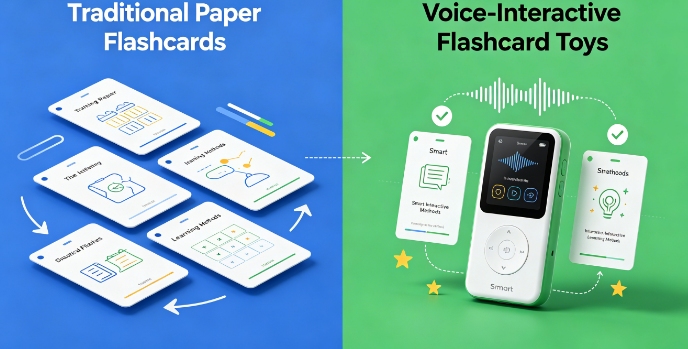
Learning Method: Passive vs Interactive Experience
One of the most obvious differences between traditional flash cards and talking flash cards is the learning approach they provide. Traditional flash cards rely mainly on visual memory and teacher or parent guidance.
Key differences include:
- Traditional flash cards: Require adult instruction and verbal explanation to teach pronunciation and meaning.
- Talking flash cards educational toys: Provide built-in audio that pronounces words automatically when a card is used.
- Learning style: Traditional cards focus on memorization, while talking versions promote active interaction.
- Child engagement: Interactive audio feedback increases participation and curiosity.
This shift from passive learning to interactive engagement makes talking flashcards more suitable for modern early education needs.
Sensory Learning: Single vs Multi-Sensory Input
Another major difference lies in how information is delivered to children. Traditional flash cards mainly rely on visual stimulation, while talking flash cards combine multiple senses.
Key comparisons include:
- Visual-only learning: Traditional cards use images and text to convey meaning.
- Audio-visual integration: talking flash cards educational toys combine images with spoken pronunciation.
- Enhanced memory retention: Multi-sensory input improves information absorption and recall.
- Stronger learning connection: Hearing and seeing simultaneously helps children understand concepts faster.
By engaging multiple senses at once, talking flashcards create a richer and more effective learning environment.
Independence and Ease of Use
Ease of use is another important factor that distinguishes these two learning tools. Traditional flash cards often require adult involvement, while talking versions support more independent learning.
Key differences include:
- Traditional flash cards: Parents or teachers must guide pronunciation and correct mistakes.
- Talking flash cards educational toys: Allow children to learn independently through built-in voice instructions.
- Self-paced learning: Children can repeat words as many times as needed without supervision.
- User-friendly design: Simple card insertion or scanning makes the operation easy for young learners.
This independence helps children build confidence and encourages self-directed learning habits from an early age.
Engagement and Learning Motivation
Children’s attention span and motivation play a critical role in learning effectiveness. Traditional flash cards may become repetitive over time, while talking flash cards offer more engaging experiences.
Key engagement differences include:
- Traditional learning style: Repetition without stimulation may reduce interest over time.
- Interactive audio response: talking flash cards educational toys provide sound effects and pronunciation feedback.
- Gamified experience: Some versions include quizzes or interactive prompts.
- Higher motivation levels: Sound and interaction keep children interested for longer periods.
As a result, talking flashcards are more effective in maintaining consistent learning motivation.
Educational Value and Skill Development
Both traditional and talking flash cards support early learning, but they differ in the range and depth of skills they develop.
Key comparisons include:
- Traditional flash cards: Focus mainly on memorization and visual recognition.
- Talking flash cards educational toys: Support language development, listening skills, cognitive thinking, and pronunciation.
- Skill diversity: Talking versions offer broader learning opportunities across multiple subjects.
- Practical application: Audio feedback helps children apply knowledge in real communication situations.
This expanded educational value makes talking flashcards a more comprehensive learning tool.
Conclusion
Traditional flash cards and talking flash cards educational toys both play important roles in early childhood education, but they differ significantly in method, engagement, and learning effectiveness. Traditional flash cards rely on visual memory and adult guidance, while talking flash cards integrate audio, interaction, and multisensory learning to create a more engaging experience. With features that support independent learning, stronger engagement, and broader skill development, talking flash cards educational toys represent a modern evolution of traditional learning tools. Choosing between them depends on the child’s age, learning needs, and educational goals, but in many cases, talking flashcards offer a more dynamic and effective approach to early education.
0