
The Variegated Ficus is a popular ornamental plant known for its strikingly patterned leaves and elegant indoor appearance. While light, watering, and temperature are important for its growth, soil quality is one of the most critical factors that determines long-term health and stability. A properly formulated soil mix ensures excellent drainage, root aeration, and nutrient availability—factors that directly influence leaf coloration, growth rate, and the overall vitality of the plant. Choosing the right soil mix helps prevent common issues such as root rot, nutrient deficiency, and slow growth, making it essential for the successful cultivation of Variegated Ficus in both indoor and outdoor environments.
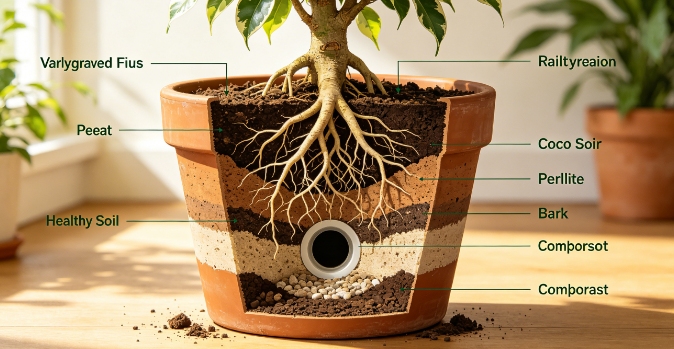
1. Key characteristics of ideal soil for Variegated Ficus
A suitable soil environment for a Variegated Ficus must balance moisture retention with good drainage and air circulation around the roots.
- Excellent drainage capacity:
The soil should allow excess water to flow out quickly to prevent root suffocation and fungal infections caused by waterlogging. - Moderate moisture retention:
While drainage is important, the soil must still retain enough moisture to support consistent hydration between watering cycles. - High aeration structure:
A loose soil texture ensures that oxygen reaches the roots, which is crucial for the healthy development of the root system and nutrient absorption. - Stable nutrient holding ability:
The soil should be able to retain essential nutrients without becoming overly compacted or chemically imbalanced.
These characteristics create a stable foundation for long-term plant growth.
2. Recommended components of a balanced soil mix
The best soil mix for a Variegated Ficus typically combines organic and inorganic materials to achieve optimal structure and performance.
- Peat or coco coir (moisture retention base):
Provides essential water retention while maintaining a light structure that supports root expansion. - Perlite (drainage and aeration enhancer):
Improves airflow in the soil and prevents compaction, ensuring roots remain oxygenated. - Pine bark or orchid bark (structure builder):
Adds texture to the mix, improving long-term drainage and mimicking natural growing conditions. - Compost or organic matter (nutrient source):
Supplies slow-release nutrients that support healthy leaf development and steady growth.
A balanced combination of these ingredients creates an ideal growing medium for Variegated Ficus.
3. Common soil mix formulas for healthy growth
Different growers may adjust soil formulations based on climate, environmental conditions, and plant size; however, for the variegated fig (*Ficus*), several reliable formulations are currently widely adopted.
- Standard indoor mix:
40% peat or coco coir + 30% perlite + 20% bark + 10% compost
→ Suitable for most indoor environments with controlled watering routines. - Fast-draining mix for humid regions:
30% peat + 40% perlite + 30% bark
→ Prevents excessive moisture buildup in high-humidity climates. - Nutrient-rich growth mix:
50% organic compost blend + 25% perlite + 25% coco coir
→ Ideal for promoting rapid growth during the vigorous growth phase. - Balanced beginner-friendly mix:
Equal parts peat, perlite, and bark
→ Easy to manage and suitable for new plant owners.
Each formula supports different environmental needs while maintaining healthy root conditions.
4. Soil-related problems and how to fix them
Even with proper soil selection, issues can still arise when growing a Variegated Ficus, especially if maintenance is inconsistent.
- Soil compaction:
Over time, soil may become dense, restricting airflow. This can be corrected by repotting and adding more perlite or bark. - Poor drainage leading to root rot:
If water remains in the pot for too long, roots may decay. Improving drainage holes and adjusting soil composition can resolve this issue. - Nutrient depletion:
Continuous growth can reduce soil fertility. Regular fertilization or soil replacement every 1–2 years is recommended. - Salt buildup from fertilizers:
Excess fertilization can cause white residue and plant stress. Flushing the soil with clean water helps restore balance.
Proper monitoring ensures long-term soil health and plant stability.
Conclusion
The best soil mix for a Variegated Ficus is one that provides excellent drainage, proper aeration, balanced moisture retention, and steady nutrient supply. A combination of peat or coco coir, perlite, bark, and organic compost creates an ideal environment for strong root development and vibrant foliage. By choosing the right soil formula and maintaining it properly over time, growers can significantly improve plant health, prevent common issues, and ensure long-lasting growth success for Variegated Ficus in any indoor or outdoor setting.
0