
Touchless Sanitation systems have become the norm in both residences and offices today. Apart from being an amenity, it is now a basic need. The Smart Sensor Trash can, besides ensuring that there is no mess, will not stink, and, more importantly, will not subject one to any bacterial contamination. With too much information regarding the various technical aspects of this equipment on the market, consumers find it hard to make an informed choice. In this article, the various dimensions of this system are analyzed to enable one to make an appropriate choice.
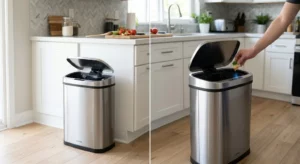
Selecting the Right Sensor Technology for a Smart Sensor Trash Can
This is very important because the sensor technology used determines the way the bin works while in use. While considering these sensors, the following should be considered:
Infrared Motion Sensor
The most popular type. Good sensors will have their detection zones at about 15-25 cm, opening time of 0.2-0.3 seconds, triggering of the lid when lifting a hand or knee.
Vibration & Kick Sensor
With hands full of food preparation debris or even dirty while cooking, just a gentle tap or kick against the body opens the bin without having to bend down.
Anti-Interference & Delay Algorithms
The advanced Smart Sensor Trash Bin features microprocessors integrated with interference-resistant algorithms. These differentiate between people walking by and deliberate triggers, leaving the lid open until actual usage, when a smooth countdown of 5 seconds is initiated, after which it shuts.
Select the Ideal Capacity and Dimensions for Your Needs
Correct sizing based on the intended use of the room prevents not only frequent emptying but also buildup of old waste within your household or workplace.
| Application Space | Recommended Capacity | Form Factor | Primary Selection Factors |
| Kitchen / Living Room | 40–50L (13 Gallon) | Standard vertical, wide-mouth | High capacity, air-tight odor seal, impact resistance |
| Bathroom / Restroom | 10–15L (2.5–4 Gallons) | Ultra-slim (~15 cm width) | High-grade waterproofing, compact footprint, quiet closure |
| Bedroom / Study | 12–20L (3–5 Gallons) | Minimalist cylinder/rectangle | Silent operation, soft-close dampers, odor confinement |
| Desktop / Office | 3–5L (0.8–1.3 Gallon) | Miniature tabletop | Small footprint, refined aesthetic, quick access |
Select Material & Waterproof Classification according to Installation Setting
The selection of exterior material affects aesthetic appearance since it affects the durability and strength of the structure.
When it comes to bathrooms and kitchens, brushed finish 430 stainless steel with an anti-fingerprint coating enables easy oil wiping, structural integrity, and effective odor insulation. However, in wet environments like the bathroom, ABS or PP high-density plastics provide a good solution due to their waterproof nature.
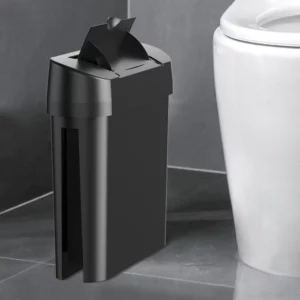
Waterproofing should be considered with utmost importance because the presence of moisture results in short-circuit problems in the sensor housing when the latter is not waterproofed. In such a case, the need arises to go for a smart trash can that is waterproofed. For instance, CD-7002 of the brand name CDWK is one such design. It is specifically designed for use in bathroom environments, and it is water-resistant with an IPX5 rating together with a 15 L capacity and 26.5 x 18.5 x 30.5 cm size, which fits between the toilet.
Compare Power Supply Solutions and Determine Battery Lifespan
A stable power supply is crucial for the proper functioning of your sensors. Today’s range of Smart Sensor Trash Cans can be grouped by the following power supplies:
Replaceable Dry Batteries (AA/AAA)
Does not require any wall outlet or transport to recharge. With normal home use (20 to 30 times of opening and closing every day), high-quality alkaline batteries provide you with 3 to 6 months of constant performance.
Rechargeable Lithium Batteries (Type-C USB)
1200 mAh to 2000 mAh lithium batteries get recharged completely in 2 to 4 hours, which gives 2 to 4 months of performance after charging. This battery type helps reduce the cost of their disposal in the long run as well as provides you with an ecological power supply.
Consider Additional Smart Sensor Trash Can Features
Apart from the automatic opening system, there are secondary functions aimed at solving specific problems in each family depending on your budget:
Self-Sealing & Auto-Replacing System
A one-click sealing process allows you to seal the inner bag without touching waste. The inner bag is sealed by built-in fans with negative pressure.
Dampening Soft Closing Mechanisms
The hydraulic or gear dampeners keep the volume of closing noise below 30 decibels and prevent noise pollution late at night.
Odor Sealing and Carbon Units
Silicone seals contain volatile gases, while built-in carbon trays accommodate activated carbon packets or deodorizers to help neutralize kitchen waste odors.
Determining Bag Compatibility and Consumption Costs of the Liners
People often forget about continuous bag costs when buying a Smart Sensor Trash Can.
Universal Bag Fit Design
Trash cans equipped with internal retention rings or concealed tension clips fit regular flat and drawstring liners that can be purchased from any store. Such a design will ensure low ongoing costs and flexible buying options.
Custom Refill Ring Cartridges
These ring cartridges go along with an automated self-closing mechanism. Offering ultimate convenience, they demand a continuous supply of special consumables. Finding a balance between annual consumption budget and ease of use will help you stay satisfied with your purchase.
Conclusion
Choosing the proper Smart Sensor Trash Can is as easy as choosing based on your actual household needs. By aligning the level of sensitivity, room size, waterproof construction, power source type, and compatible waste types according to your everyday routine, you make sure of purchasing a reliable touch-free trash management system.
FAQ
Q1: What is the battery life of a Smart Sensor Trash Can?
Answer: The period of its activity depends on the frequency of cycles and battery type. Regular dry cells or rechargeable lithium batteries will normally work for 3 to 6 months at the average rate of usage (up to 20-30 openings daily).
Q2: Will a Smart Sensor Trash Can allow me to use regular plastic bags?
Answer: It is possible to put in most of the common models any regular plastic flat or drawstring bag. Automated models with thermal self-sealing only need dedicated refill rings.
Q3: Are smart sensor trash cans waterproof, and can they be used in bathrooms?
Answer: Not all models are waterproof. For bathroom installation, check whether the particular product has a waterproof design with an IPX3 or IPX5 rating.
0