
The moment one notices the S-shaped ficus bonsai, it catches one’s attention due to its elegance and its gracefully twisted trunk. Nevertheless, one common query that most potential customers make is whether such a unique plant will be difficult to maintain. Well, the answer is absolutely no; in fact, an S-shaped ficus bonsai tree is considered one of the easiest-to-care-for plants, which makes it popular among beginners and even experienced bonsai growers alike.
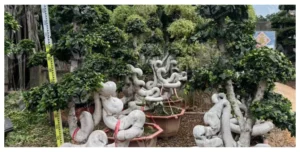
1. Why Is the S-Shaped Ficus Bonsai Tree Perfect for Beginners?
Unlike the irritable temperate varieties like Japanese black pines and maples, the S-shaped ficus bonsai (which is usually produced using the Ficus microcarpa variety) needs less effort to be cared for.
Resilience:
The strong wood and large leaves ensure that the ficus stays undisturbed even when it is not watered regularly or subjected to changes indoors.
Natural Aesthetic Balance:
The natural “S” shape is cultivated during the young age of the tree by using the soft wiring method. When you buy an S-shaped ficus bonsai, the natural “S” shape is already established and woody; hence, the beauty is set and does not require any further wiring skills to maintain it.
Value for Money and Quick Results:
The bonsai tree grows well in simple indoor lighting conditions, providing the quick aesthetic value of bonsai trees.
2. Essential Care Parameters for S-Shaped Ficus Bonsai
Keeping an S-shaped ficus bonsai healthy boils down to replicating its native tropical environment through a few specific parameters:
| Care Aspect | Recommended Range | What to Watch Out For |
| Light | 4–6 hours of bright indirect light daily (1,500–3,000 foot-candles) | Avoid harsh mid-day summer sun; dim corners lead to leaf drop |
| Temperature | 18°C–28°C (65°F–82°F); minimum 10°C (50°F) | Protect from cold winter drafts or direct heater exhaust |
| Humidity | 50%–70% relative humidity | Low indoor humidity causes crisp leaf tips; use a pebble tray |
| Soil pH | 6.0–6.5 (Slightly acidic) | Must be highly porous to prevent waterlogging around roots |
Light and Location Setup
Positioning your S-shaped ficus bonsai near windows that face eastward or southward ensures it gets the steady ambient lighting it loves. If you lack access to sunlight, use a 20W LED grow light that is 12-18 inches above the foliage for 8-10 hours daily to maintain healthy, thick foliage.
Watering & Soil Moisture Control
Continue with the old-school method of “soak and dry,” where you stick your finger inside the potting mix up to 1 inch. If the soil is dry, you should then proceed to water heavily until you can see water seeping out from the drainage holes. It should take 3-5 days for the growing season, 7-10 days during the winter.
2. Soils & Proper Repotting Methods
Aeration of the soil helps prevent root rot, which is the number one killer of trees indoors. The recommended soil mix is as follows:
- 40% Akadama (or baked clay)
- 30% Pumice or Lava rock
- 30% Organic compost/potting soil
Repotting of your S-shaped ficus bonsai should be done once every two years during the onset of the spring season when temperatures reach about 20°C (68°F). Prune 20% to 25% of the largest circling roots in order to encourage new feeder roots without shocking the tree or making it leave its beautiful desktop pot.
4. How to Maintain the S-Shape Ficus Bonsai Aesthetics
Pruning of S-shaped ficus bonsai is geared toward maintenance of foliage pads instead of altering the form of the main trunk.
Pruning and Shaping Techniques
When a new shoot grows to a total of 6 to 8 leaves, prune back to only 2 or 3 leaves, leaving 0.5 cm above an outer-facing node at a 45-degree angle. This is done in order to prevent the tree from being leggy and stimulate back budding in inner branches.
Aerial Root and Jungle Style Management
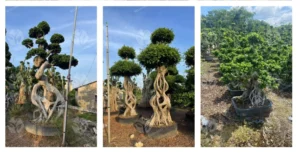
However, under humid conditions, aerial roots are naturally dropped by the ficus trees from their lower branches down to the ground. As they develop, the roots grow thicker and wrap around the stem, forming a beautiful “miniature jungle.” High-quality specimens such as S-shaped jungle banyan trees, Ficus microcarpa from Wulalagarden, display this natural process beautifully – combining the beautiful “S” stem with the thick, intertwined aerial roots. They make a great centerpiece for your desk or living room table, giving you an ancient rainforest look without the trouble of working on the trunk.
5. Common Problems with S-Shape Ficus Bonsai
Any sign of stress in your S-shaped ficus bonsai is most likely caused by a recent change in the environment:
Leaf Fall
- Cause: The plant is frequently moved or placed in an area of strong currents and rapid fluctuations in humidity.
- Solution: Ensure that the plant stays in one spot with enough light and moisture so that the buds can form in 2 to 3 weeks.
Yellowing Leaves and Soft Stems
- Cause: Excessive watering causes poor exchange of oxygen in the soil, as it is oversaturated with water.
- The solution is to stop watering the plant and make sure there are no drainage problems with your pots. Let the soil on top become completely dry.
Pest Infections
- Cause: Scale or spider mites in dry indoor air.
- Solution: Spray the leaves with organic Neem oil (at the 1:200 ratio) diluted in water every week for 3 weeks.
6. Is an S-Shape Ficus Bonsai a Good Purchase?
Overall, purchasing an S-shaped ficus bonsai is one of the best deals because it is a combination of plant artistry and practicality. It is much more interesting compared to a regular houseplant, but at the same time not as complicated to maintain as pines or maples. You just need to follow the basic scheme of watering and trimming in order to maintain its beauty for years to come.
0