
Maybe it is not much, but it could still lead to a significant overall product loss during the entire production shift.
The use of the automatic liquid filling machine will definitely provide consistency in dispensing, but reducing losses would require having the right pumps, nozzle alignment, the right product, and, of course, proper changeover procedures. At first, you need to determine the reason those losses occur.
1. Common Causes of Liquid Waste During the Filling Process
Before making adjustments, manufacturers need to identify where liquid waste occurs. Most losses can be traced to several stages of the filling process.
Overfilling and Inconsistent Filling Volumes
The first reason for the material wastage is overfilling. When there is more actual volume filled than expected, the extra volume remains constant throughout the manufacturing process. The reasons for overfilling include inaccurate parameters for filling, pump malfunction, and miscalibration. The temperature and viscosity of the liquid could also influence the filling process.
A filling line working at the speed of 2000 bottles per hour and overfilling by 5 ml per bottle would cause the wastage of 10 liters per hour, which equals 80 liters in an 8-hour shift.
Nozzle Dripping and Splashing
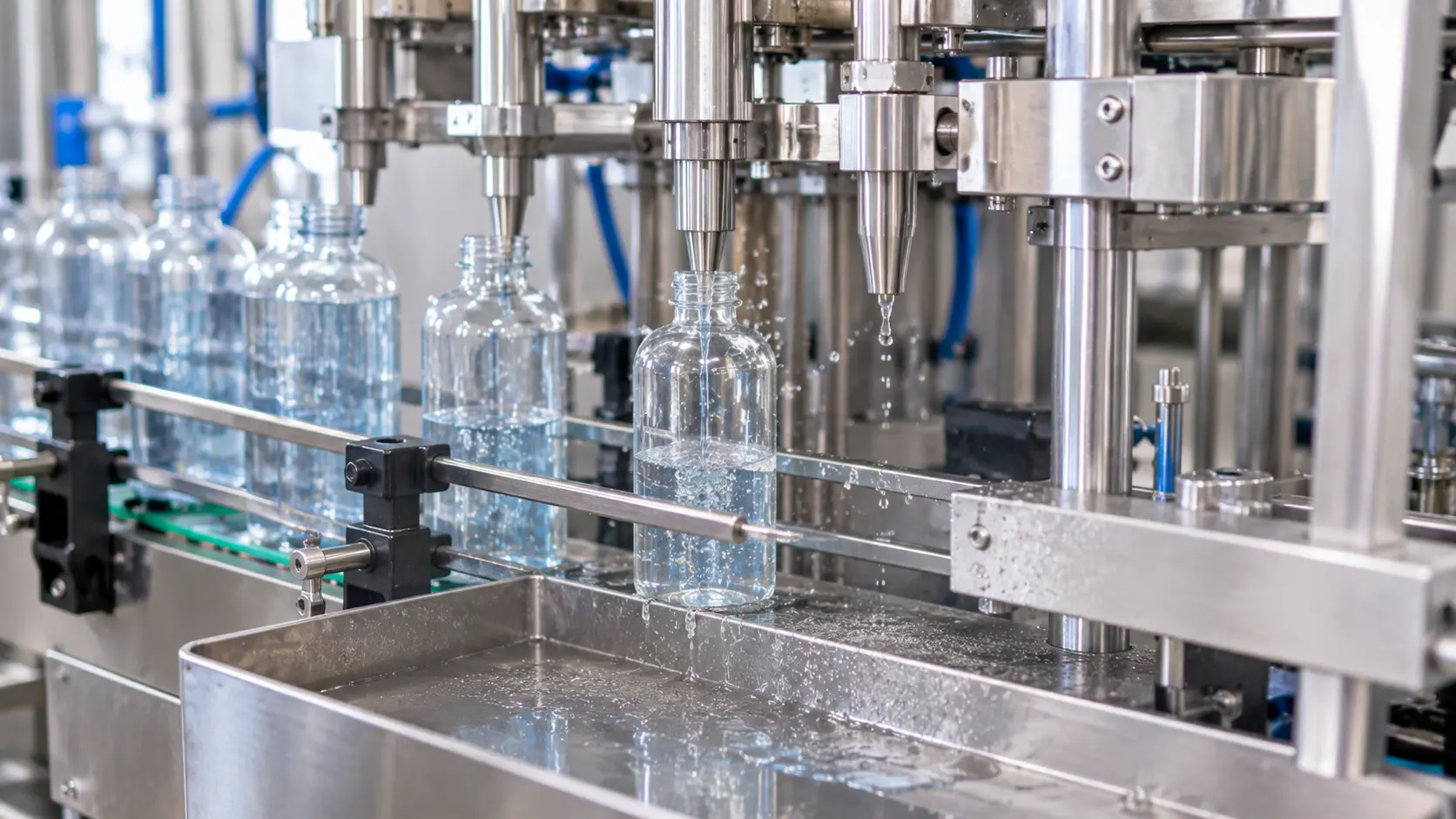
The amount of liquid that remains at the nozzle end every time the filling process takes place may become less due to sealing issues, delayed sealing, or the use of the wrong nozzle. There is also spillage that may occur due to fast filling and positioning the nozzle away from the mouth of the bottle. Foaming can also cause spillage.
Residual Product in Pipes and Tanks
The product does not get to the container because some of it remains in the pump, pipes, storage tanks, and hoses used to transfer the product. This is due to the presence of long pipelines, many bends in the pipelines, and poor drainage. These losses become apparent in cases where there is always a change in the products being manufactured.
2. Key Factors That Affect Liquid Waste in an automatic liquid filling machine
The quantity of product lost in the filling process is determined by the compatibility of the machinery with the liquid to be filled and the required production process. Technical issues need to be considered.
Liquid Viscosity and Flow Characteristics
An automatic liquid filling machine must be set up based on the fluid viscosity and flow properties, not just the desired fill amount. In thin fluids, dripping can happen in a poor shutoff system, while thick fluids may need alternative pump systems and wider flow rates. Check the formulation under regular manufacturing circumstances since temperature changes will influence flow and dose amounts.
Filling Accuracy and Pump Performance
The accuracy of dosage depends on the metering mechanism, calibration, and stability of the substance being supplied. Dosing in piston fillers is determined through the displacement of the piston, while the displacement of peristaltic fillers takes place as a result of squeezing the flexible tubes.
An example of a device that could be regarded as suitable is the ZS-YT2T-2PXD Automatic 2 Heads Servo Piston Pump Liquid Soap Filling Machine with servo-piston metering of liquid soap. The suitability of such a device needs to be verified through practice.
Nozzle Design and Filling Position
Selection of a proper nozzle influences shutoff efficiency, splash formation, and the amount of liquid left in the nozzle after discharge. An appropriate anti-drip nozzle may prevent dripping between refills, whereas diving nozzles can be used to control splash and foam formation, if properly installed.
Examine nozzle position, insertion, dispensing, and shutoff simultaneously. Tracking nozzles track moving containers; however, tracking alone does not necessarily imply less waste; the dispensing and shutoff should also be checked.
3. Practical Ways to Reduce Liquid Waste with an automatic liquid filling machine
Once the main sources of waste are identified, manufacturers can improve material efficiency through equipment adjustments and better production procedures.
Optimize Filling Volume and Speed
Prior to making changes to the automatic liquid filling machine, it is necessary to look at the results of the fill compared to the desired quantity and see the variations from trial to trial. The adjustment has to be made to the particular pump, piston, or flow meter, after which a test needs to be done using the actual product.
If the formula makes splashes and foams, a fast beginning and slower ending may do the job well.
Choose Suitable Nozzles and Pump Systems
The filling elements should be chosen based on the viscosity of the product and the packaging system used.
• Anti-drip nozzles can be employed in the case of dripping of the liquid from the nozzle.
• The use of diving nozzles can help when liquid splashing and foaming occur.
• Choosing the pumps should be based on the viscosity of the product, dosing precision, and material of the pump.
There are no universal nozzles and pumps that can be used for all types of liquids. Testing of the product is required.
Reduce Residual Product and Improve Cleaning Procedures
Inspect the product flow path in the automatic liquid filling machine to identify low areas, excess hose, and non-drainable areas. Make improvements wherever possible and recover the product in a recognized process. There will be loss when changing products and cleaning. Although grouping batches of production is a way to reduce the number of changes, it still needs to be done right.
Monitor Waste with Production Data
Track product quantities over a defined batch or production period, using consistent units. Account for opening and closing inventory, usable product remaining in the equipment, and material recovered for approved reuse.
Unrecovered loss rate = Unrecovered product loss ÷ Product input × 100%
For example, if 1,000 liters enter a batch, 980 liters reach accepted bottles, and 10 liters remain usable and recoverable, the unrecovered loss is 10 liters, or 1%, assuming no other inventory changes. Track overfill separately as product giveaway. Product inside accepted bottles may exceed the target quantity without appearing as an unrecovered loss.
Conclusion
However, more is required in order to reduce waste formation besides using automatic liquid filling machines. Equipment choice should be based on the formulation, especially dose delivery, the shutoff mechanism of the nozzle, and potential loss during manufacturing and changeover. This information could assist in modification. Modifications that would be most effective should be those that would minimize wastage without affecting the fill process.
0