
Every year in early November, all of Mexico is flooded with flowers, lighting, decorations, painted skulls, and family reunions. On the surface, it may seem rather unusual to celebrate the death of people in such a manner. For the majority of Mexican families, the Day of the Dead does not represent a particularly solemn holiday. Instead, this is a time for honoring the memory of one’s beloved relatives and deceased members of the family.
Why do Mexicans celebrate the Day? What is the meaning of marigolds, skulls, lighting, and sugar skulls during this celebration?
1. Day of the Dead: What Do You Know?
Día de los Muertos, or the Day of the Dead, is traditionally celebrated on November 1 and 2 in Mexico. Still, for a long time prior to these dates, people start making preparations. They prepare food, buy flowers, clean graves, and make altars at home. The particular customs may vary from region to region, but the main idea remains the same – the remembrance of departed relatives and friends.
There are very old roots of the holiday. Before the Spanish colonization of Mexico, the local Indigenous peoples practiced certain ceremonies related to the dead and connected with the relationship between life and death. The custom of honoring the dead started to merge with other customs associated with Christianity – All Saints’ Day and All Souls’ Day. This process took place gradually for several generations and resulted in the emergence of the current holiday – Día de los Muertos.
The most amazing thing about the holiday is that there is a unique approach to the concept of death. It does not mean that people do not feel sad, but there are things that take place when people remember the departed. A family might put a grandmother’s favorite food on the altar, display an old photograph, or tell stories about a relative who is no longer around. For a short time, the memories of that person become part of the family’s daily life again.
2. What Do Marigolds, Skulls, and Altars Represent?
The colorful decorations associated with the Day of the Dead are more than simple holiday ornaments. Many of them have a specific meaning and have been passed from one generation to another.
| Symbol | Meaning | Common Forms |
| Marigolds | A symbolic connection between the living and the dead | Flowers, garlands, altar decorations |
| Skulls | A different, less fearful view of death | Masks, artwork, figurines |
| Candles | A symbolic guide for the returning spirits | Altars and cemetery decorations |
| Photographs | A personal way to remember loved ones | Family altars |
| Ofrenda | A place to honor and welcome the dead | Home altars and displays |
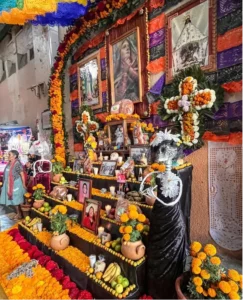
Of all these symbols, the marigold is especially distinguishable. The flower’s distinctive bright orange and yellow color contrasts with the more somber backgrounds of cemeteries and altars. In the traditional celebration of Día de los Muertos, the marigold flowers are placed around graves, on altars, or used for pathways and other decorations.
Another symbol widely recognized during Día de los Muertos is skulls. Yet the skulls that are used during the celebration are usually much less scary than those of Halloween – often decorated with flowers, bright colors, patterns, and happy faces. It symbolizes an attitude of accepting death not just as something scary.
In the center of many rituals lies an ofrenda (an altar). On the ofrenda, people can place photos of the dead person, candles, flowers, food and drinks, and personal belongings of the departed. Each family organizes the ofrenda differently.
3. Why Are Sugar Skulls So Popular?
There is no better symbol of the Day of the Dead than the sugar skull (calavera de azúcar).
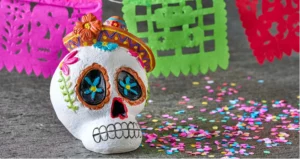
Generally consisting of sugar and brightly colored frosting, sugar skulls may sometimes have intricate designs. While some are designed for consumption, others are simply works of art. The skull design is commonly found in many different types of crafts such as ceramics, woodworking, paper ornaments, masks, and so forth.
Sugar skulls are especially fascinating in how they turn the image of death into an artistic, bright creation. Rather than conceal the notion of mortality, the designs celebrate life and memory instead.
In addition, there may even be names on some of the sugar skulls that belong to certain individuals. Today, the skull design is very popular and is incorporated into Day of the Dead decorations in products such as:
- Painted skull masks
- Sugar skull ornaments
- Skull-themed figurines
- Marigold garlands
- Colorful paper decorations
- Ofrenda accessories
- Handmade ceramics and crafts
These items are not simply souvenirs. When used in the proper cultural context, they help express the visual language of the holiday.
4. From Traditional Ritual to Modern Festival: How Did the Day of the Dead Go Global?
In previous years, the Day of the Dead festival was mostly celebrated inside Mexican families and communities. Nowadays, however, the symbols of the holiday have become well-known even outside Mexico.
In the process of celebrating, people are able to make an altar at home, visit the cemetery to clean up and decorate graves, and honor their ancestors. There are celebrations on the streets in some cities: there is a parade, music, and performances.
The films, fashion, tourism, and design became associated with the Day of the Dead. Skulls painted in different colors, marigolds, papel picado, and floral motifs became the symbols of Mexican culture.
However, it needs to be pointed out that the Day of the Dead is not merely the celebration of death associated with the aforementioned elements of décor. The visual representation of this celebration is based on something much larger – traditions related to family and memories, traditions respecting the dead. Understanding that makes it easy to perceive all the decorative elements in their full value.
Conclusion
Therefore, the Day of the Dead gives a unique outlook on death and memorials. Even though the marigolds, candles, photos, altars, and sugar skulls may seem merely like decorations, they all have the potential to serve as symbols of family history and an individual’s reminiscences.
The further development of this tradition remains unique because the people find ways to remember their deceased loved ones with flowers, food, handicrafts, ceremonies, and festivities. Maybe this is why the Day of the Dead remains so unique. The Day of the Dead is not only a celebration of the dead but also a family heritage.
0