
In contemporary commercial spaces and public washrooms, touchless hygiene requirements have progressed from being a luxury to a necessity. According to public health statistics, manual dispensers accumulate over 20 times the level of bacteria on their push bars compared to motion sensors. For facility managers, property managers, and B2B buyers, choosing the right Automatic Paper Dispenser influences day-to-day maintenance costs and user experience. Choosing between cost-effective paper use, energy-saving mechanisms, spatial efficiency, and durability calls for a systematic buying process.
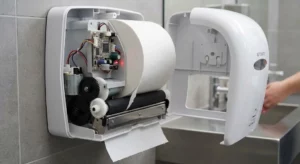
Key Points to Be Considered While Purchasing an Automatic Paper Dispenser
Choosing an Automatic Paper Dispenser includes not only considering its visual appeal but also assessing its motor efficiency and sensor reliability using seven key engineering criteria:
(1)Power Source Arrangement
There are two main types of energy sources in the market: battery-powered and AC hard-wired devices. The battery-powered models offer great flexibility of installation as they do not require electrical conduits on the walls, using four D-cell alkaline batteries as the energy source. The most efficient internal drive allows for 10,000 to 15,000 cycles from one battery pack, thus ensuring a 6- to 12-month operating period. The hard-wired AC units are best for heavy transit centers where easy replacement of the batteries is ensured because of continuous power availability.
(2) Settings and Adjustments of Paper Dispensing
Too much paper pulled is one of the biggest wastes in commercial restroom operations. There are dual adjustment settings available in the Advanced Automatic Paper Dispenser unit:
- Sheet Length Adjustment: Preset lengths of the sheets (8 inches/20 cm, 10 inches/25 cm, and 12 inches/30 cm) make sure that the user receives only what is necessary for single-use hand drying without any extra pull.
- Dispensing Delay Setting: Adjustable delay between pulls (1 to 5 seconds) prevents fast multi-sheet pulls and reduces paper usage by 25% to 35%.
- Trigger Methods: Units have either auto-dispense (pre-cuts paper which is immediately available for use) or on-demand sensor types to cater to differing traffic flows and sanitation requirements.
(3) Paper Towel Compatibility and Overall Cost
Selecting an Automatic Paper Dispenser that is universal in nature will ensure compatibility with paper rolls with maximum outer diameters of 180 mm to 200 mm. A universal unit safeguards companies from entering into lock-in agreements with a single-source supplier who sells refills at an expensive cost. Within a span of three years, opting for an open roll unit saves costs in overall total cost of ownership (TCO).
(4) Capacity and Materials of Durability
Choice of enclosure materials determines both durability of structure and cleaning capabilities since high capacity paper rolls are used in high-traffic areas:
| Material Type | Vandalism Protection Level | Chemical & Corrosion Resistance | Cost-Effectiveness | Overall Durability Rating |
| Engineering ABS Plastic | ⭐⭐⭐ | ⭐⭐⭐⭐⭐ | ⭐⭐⭐⭐⭐ | ⭐⭐⭐⭐ |
| 304 Stainless Steel | ⭐⭐⭐⭐⭐ | ⭐⭐⭐⭐⭐ | ⭐⭐⭐ | ⭐⭐⭐⭐⭐ |
(5) Ease of Installation and Maintenance
Efficient designs enhance the day-to-day activities of the cleaners and save labor costs. The combination of a transparent refill window provides visual inspection of the roll level without having to open the cabinet door. Furthermore, a robust key-locking system secures paper rolls inside the cabinet from any form of theft or tampering.
(6) Sensor Sensitivity and Accuracy
Top-notch infrared sensors should have a narrow detection range of 3 to 10 centimeters with a fast response time of less than 0.5 seconds. Proper calibration of sensors avoids delays due to lack of responsiveness of the system and minimizes false alarms caused by fluctuations in light sources or stainless steel tiles.
(7) Noise Level Management
Sometimes acoustic characteristics of dispensers are forgotten in the procurement stage. Selecting units with noiseless brushless motors ensures that the sound level remains strictly below 55 dB.
Selecting Automatic Paper Dispensers for Various Purposes
Different facilities require different performance of Automatic Paper Dispensers:
Commercial Offices and Luxury Hotels
Corporate settings require low noise emission, compactness, and elegant aesthetics. Brushed 304 stainless steel housing or sleek matte ABS models with subdued status LED lights are ideal for matching high-end architectural interiors and aligning with contemporary corporate environmental initiatives.
High-Traffic Public Spaces
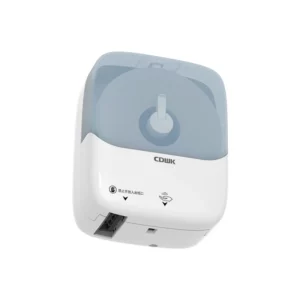
Public places such as airports, train stations, stadium facilities, and shopping centers require high paper roll capacity, dispensation speed, and impact resistance. For high-use situations, commercial units like CDWK’s CD-8809 ensure great performance and dependability. Constructed of strong, high-impact ABS, this Automatic Paper Dispenser contains an infrared hand sensor that works within 0.5 seconds of activation. This model also has a transparent viewing window through which janitors can check the paper roll level without having to open the device; its key-lock mechanism keeps the rolls safe inside in the crowded public bathroom.
Health and Food Production Settings
In hygienic spaces, an automatic dispenser has to be completely enclosed with no touch points to avoid contamination. A totally enclosed Automatic Paper Dispenser whose exterior has smooth lines is easy to disinfect with medical-grade disinfectant and is protected from water entry during the washdown process.
Procurement Workflow and Operational Best Practices
The implementation of a touchless paper dispenser fleet demands a careful process to ensure longevity and maximize ROI:
Pre-Purchase Audit of Facility:
Assess current electrical socket positions, clearances of wall mounts, and past daily consumption of paper rolls to determine correct roll capacity requirements.
Restroom Standardization of Model:
Using the same Automatic Paper Dispenser model in the whole building will make maintenance training easier, standardize key access, and enable large quantity orders of generic paper rolls.
Regular Maintenance Schedule:
Schedule quarterly cleaning of sensor windows with microfiber cloths, checking of battery terminals for oxidized connections, and lubrication of drive gears.
Purchasing Summary
Choosing a high-quality Automatic Paper Dispenser requires weighing both the cost of the hardware itself, the ongoing cost of consumables, and user capacity. Before creating the order of the purchase, it is important for the facility manager to estimate average daily use of the restroom, clear mounting space, and feasibility of installation, along with the presence of a reliable local paper source. The purchase of a properly selected Automatic Paper Dispenser will increase standards of sanitation in public facilities and will result in considerable annual savings in manpower and materials.
0