
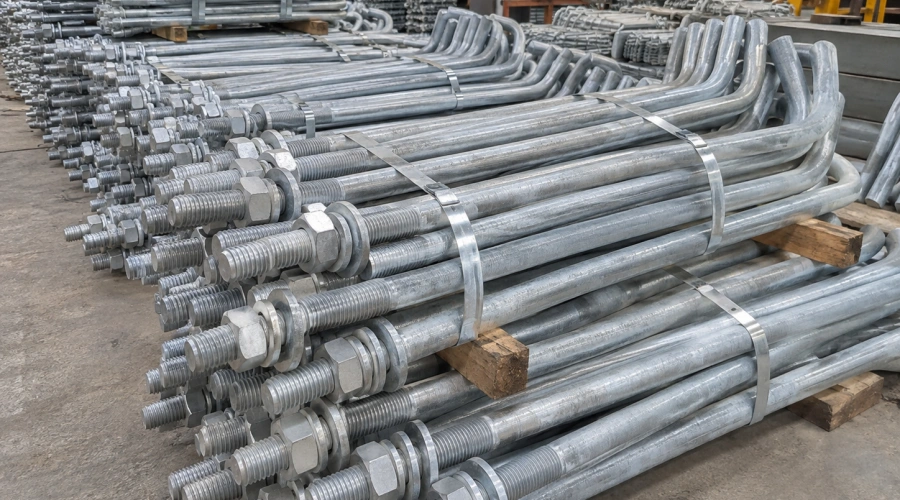
Galvanized anchor rods can be seen in structural foundations, steel assemblies, and ground anchoring. However, the standards concerning the products differ in accordance with their structure and usage. There exist several types of standards: some focus on the tensile strength and diameter of steel, others – on the quality of the zinc coating, some – on corrosion resistance, etc.
However, there are no universal standards for all galvanized anchor rods. It is crucial to make a distinction between structural anchor rods and self-drilling ground anchors.
1. What ASTM Standards Apply to Galvanized Anchor Rods?
The standards set out by ASTM make a distinction between the mechanical properties of the steel anchorage rod and the performance of the coating system. Following the material standard does not guarantee adherence to the galvanizing standard.
1.1 What Does ASTM F1554 Specify for Anchor Rods?
ASTM F1554 is a specification for steel anchor bolts used to secure structural supports to concrete foundations. This specification has some requirements for material grade, physical properties, and testing.
The specification includes three principal strength grades:
| Grade | Minimum Yield Strength | Typical Application |
| Grade 36 | 36 ksi (248 MPa) | General structural foundations |
| Grade 55 | 55 ksi (379 MPa) | Structural connections requiring higher strength |
| Grade 105 | 105 ksi (724 MPa) | High-strength anchoring applications |
The above-mentioned values are minimum yield strength specifications, not allowable working loads. The actual load capacity is also dependent on the diameter, cross-sectional area, connection type, and conditions of concrete anchorage.
It should be noted that ASTM F1554 does not apply to all self-drilling ground anchors. Moreover, it does not independently specify whether the zinc coating meets corrosion resistance criteria.
1.2 Which ASTM Standards Cover Hot-Dip Galvanizing?
The galvanized anchor rods can be subject to further coating specifications based on their design and categorization.
ASTM F2329/F2329M is the standard specification for hot-dip galvanizing of applicable threaded steel fasteners, including coating thickness, appearance, and inspection.
ASTM A153/A153M provides hot-dip zinc coatings on iron and steel hardware with requirements that differ according to product type.
ASTM A123/A123M specifies hot-dip galvanized coatings on specific structural steel products and fabricated assemblies. However, it does not necessarily supersede the specifications for threaded fasteners.
The correct specification will depend on the type of product, its size, and the method of manufacturing. Not all galvanizing specifications need to be applied to each rod.
2. What International Standards Apply to Galvanized Anchor Rods?
ISO standards and European construction standards can also be used in international projects. This is because various elements of quality are covered by such standards, including coating thickness and anchoring system performance.
2.1 How Do ISO Standards Address Galvanizing and Corrosion?
Many test specifications have been included in ISO 1461 for hot-dip galvanized coatings on wrought iron and steel articles. For example, as per the test specifications, steel articles with a thickness greater than 6 mm should have a local coating thickness of at least 70 μm and an average coating thickness of 85 μm. This is not the specification for all anchor bolts.
ISO 10684 concerns the hot-dip galvanization of suitable threaded fasteners, with details on coatings and suitability of threads.
ISO 9223 defines six corrosivity classes in terms of atmosphere from C1 through CX. C1 is considered a very low corrosivity class, whereas CX is an extreme one.
The classification system helps determine the corrosivity of exposed steel structures, but it does not substitute for a site corrosion survey for buried anchors.
2.2 What Standards Apply to Self-Drilling Anchor Rods?
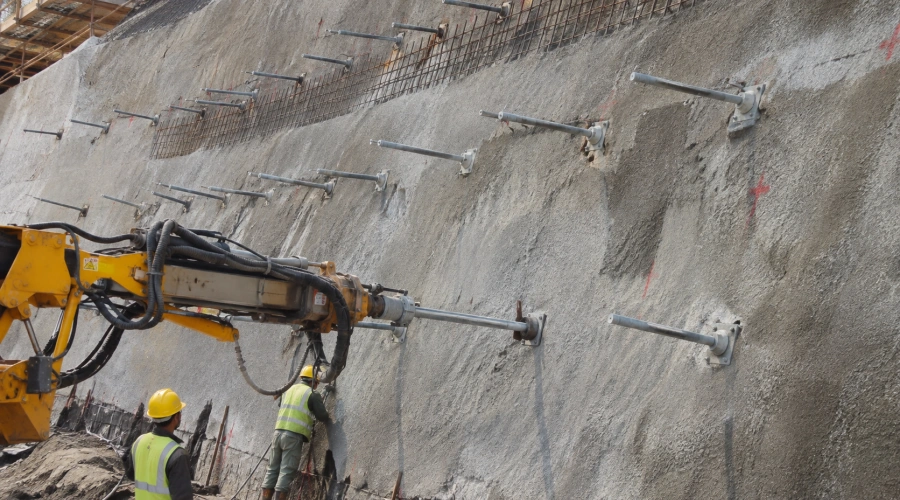
Self-drilling anchor rods are not the same as anchor bolts installed within concrete. These rods usually have hollow threaded steel rods, which permit drilling and grouting to be done during the anchoring process. The effectiveness of self-drilling anchor rods is influenced by factors other than just the strength of steel and quality of galvanization. Other factors that affect self-drilling anchor rods include the tensile strength of the rod, coupler performance, and grout quality. In European construction practices, EN 1537 specifies the installation of ground anchors, whereas EN 14490 specifies soil nailing.
A typical example is ONTONBOLT’s HDG Coating Self-drilling Anchor Rods. These rods feature a hot-dip galvanized coating and are used in applications such as slope stabilization and retaining wall support. Their suitability must be evaluated through coating quality, mechanical properties, and the design requirements of the complete anchoring system.
2.3 How Can You Verify Compliance with the Required Standards?
The confirmation of galvanized anchor bolts goes beyond just verifying a product specification. Documents and tests need to confirm whether the requirements have been met.
Material Verification
It is important to check the steel grade, yield strength, tensile strength, and the material test report. The mechanical test results must agree with the product specification.
Inspection of the Coating
The zinc coating can be assessed using methods approved by the standard. The inspection will also involve examining areas that have no coating and defects.
Dimensions and Connections Checks
Ensure that the rod diameter, length, thread dimensions, and connections match. Self-drilling drill strings also need to check the coupler.
System Level Testing
In terms of ground anchoring systems, the use of components that meet the standard does not necessarily ensure an installation that meets the standard.
The inspection records must be traceable to the delivered production lot rather than just the standard for the product.
Conclusion
The standards required for galvanized anchor rods will vary based on the construction type and application. The specifications that apply to material requirements for structural anchor rods are covered in ASTM F1554. The galvanization process is covered in ASTM F2329/F2329M and other associated standards.
ISO 1461, ISO 10684, and other European construction standards contain additional requirements for coating and engineering uses. A proper compliance review requires choosing the right standards and testing the material properties, coatings, and installation performance.
0