
In the field of optical communications, many people assume that a fiber faceplate is just a simple flat fiber interface. However, in FTTH, FTTO, or FTTD systems, a fiber faceplate is actually a multifunctional fiber outlet. It not only provides an interface for fiber signal transmission but also serves as a central point for terminal management, fiber storage, and patch cord connections. Using a fiber faceplate allows optical communication systems to manage signal distribution efficiently while keeping indoor fiber cabling organized and secure, enhancing system reliability and maintenance efficiency.
What is a Fiber Faceplate?
In indoor fiber deployment, a fiber faceplate generally refers to a fiber outlet that acts as the terminal point for introducing optical cables into buildings and distributing the signals. It integrates fiber splicing, patch cord connections, and storage into a single device. This design allows fiber signals to be distributed efficiently across 8 to 16 channels, with each fiber clearly routed and labeled to reduce tangling and damage. Compared to a simple flat fiber interface, a fiber faceplate is more than just a signal port—it is a key component that ensures the stability, organization, and safety of indoor fiber networks.
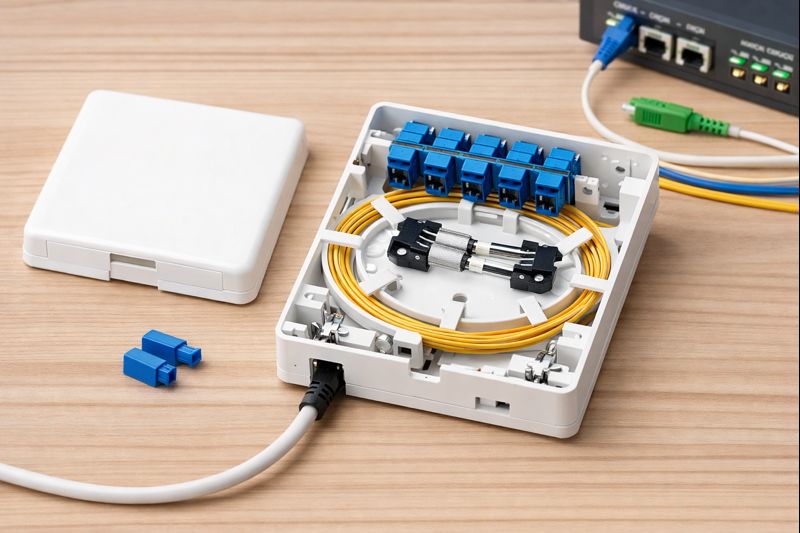
Core Functions of a Fiber Faceplate
- Multi-Channel Terminal Management
Fiber faceplates support 8 to 16 fiber channels, enabling centralized management of fiber splicing, patch cord connections, and signal distribution. Each channel has a fixed position and clear labeling, allowing installers to identify and connect fibers quickly while minimizing errors. This multi-channel design also simplifies future network expansion, making it easy to add or replace fibers without the need to rewire, enhancing overall system flexibility. - Integrated Storage and Protection
The interior of the faceplate features designated storage areas for fiber splices and slack fiber, preventing bending, twisting, or breakage. Fibers follow specific paths inside the storage area, avoiding crossovers and tangling while protecting them from external impacts. This design not only prolongs the fiber’s lifespan but also ensures stable signal transmission, reducing the risk of network failures caused by damaged fibers. - Simplified Installation
Fiber faceplates are designed for easy cable entry and patch cord connections without requiring complex tools. The structure provides sufficient space for fiber routing, with clearly defined paths for each patch cord, enabling installers to complete connections and inspections efficiently. Simplifying installation not only improves construction efficiency but also reduces the risk of fiber damage caused by human error. - Compatibility with Multiple Fiber Adapters
Fiber faceplates are compatible with SC, FC, LC, and other common adapters, accommodating various optical communication devices. This ensures that the same faceplate can be used in residential FTTH, desktop FTTD, or office FTTO applications. Wide adapter compatibility reduces installation challenges due to differing standards and increases device interchangeability. - Optimized Fiber Bend Radius
Built-in winding grooves and bend management structures ensure fibers are not forcibly bent during connection or storage, minimizing signal loss and attenuation. The routing paths maintain a safe bend radius for fibers, preventing microbends or kinks that could affect high-bandwidth network performance and signal quality. - Long-Term Stability
Fiber faceplates feature dustproof designs with an IP45 protection rating, effectively preventing dust and debris from entering and affecting fiber performance. The durable ABS housing is suitable for long-term use in both residential and office environments. Dustproofing and protection ensure stable long-term operation, reduce maintenance frequency, and improve overall system reliability.
Advantages of a Fiber Faceplate
- Integrated Design: The faceplate combines splicing, patching, and storage into one device, centralizing cable management. This reduces the complexity of fiber deployment, keeps indoor cabling organized, prevents tangling, and improves installation and maintenance efficiency.
- Improved System Reliability: Dustproof and high-protection designs, combined with bend management, effectively reduce fiber breakage and signal loss. This ensures fibers operate reliably over time, lowering failure rates and extending the life of the network.
- Multi-Channel Support: Supporting 8 to 16 fiber channels, the faceplate is suitable for residential, office, or enterprise fiber networks. Multi-channel functionality meets current requirements and allows future network expansion, enhancing flexibility and maintainability.
Conclusion
Therefore, a fiber faceplate is not just a flat fiber interface. In FTTH, FTTO, or FTTD systems, it serves as a multifunctional fiber outlet. Combining terminal management, signal distribution, storage protection, and easy installation in a single device. Understanding its functions and advantages helps users select a more efficient and reliable indoor fiber deployment solution. Improving system stability and performance and reducing maintenance costs.
0